
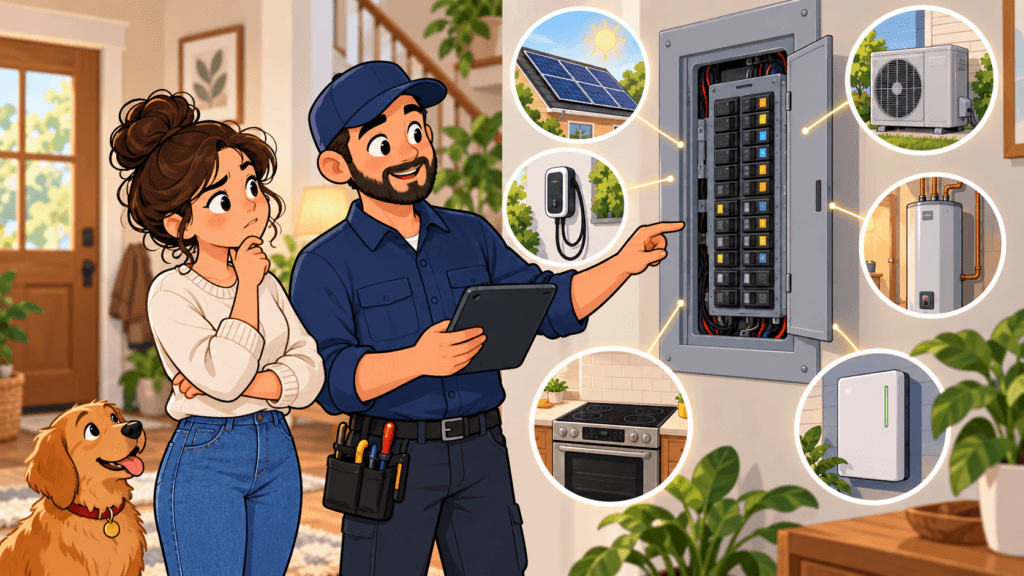
An old electrical panel does not automatically need to be replaced just because of its age.
But replacement may become necessary when the panel is damaged, overheating, corroded, unable to support new electrical loads, or no longer practical for the home’s electrical system.
The key point is simple:
One bad breaker does not necessarily mean you need a new electrical panel.
A qualified electrician should evaluate the condition of the breakers, busbars, connections, available spaces, and overall electrical capacity before recommending a full replacement.
Here are six signs that an electrical panel may need to be replaced.
1. The Panel Shows Signs of Overheating
Heat is one of the warning signs I would take seriously.
Possible symptoms include:
- Burn marks
- Melted plastic
- Dark discoloration
- Burning odors
- Unusual heat
- Buzzing or sizzling sounds
These problems can be caused by loose connections, damaged breaker contacts, excessive resistance, or other electrical faults.
Sometimes only one breaker or connection needs repair.
But if heat has damaged the panel bus or other internal components, replacing the entire panel may be the safer option.
If you smell burning or see visible heat damage around the panel, I would stop treating the issue as a simple breaker problem and have it inspected.
2. There Is Corrosion or Water Damage
Water and electrical equipment should never mix.
Moisture can enter a panel because of roof leaks, plumbing problems, condensation, flooding, or problems around the service entrance.
A little surface rust on the outside of the enclosure does not automatically mean the panel needs replacement.
But corrosion inside the panel, especially around breakers, terminals, or busbars, is more serious.
Corrosion can increase electrical resistance and damage connections over time.
If water has reached internal electrical components, the panel should be professionally inspected before continuing to use it.
3. Multiple Breakers Are Causing Problems
A breaker that trips repeatedly does not automatically mean the electrical panel is bad.
The breaker may simply be protecting the circuit from:
- Overload
- Short circuit
- Ground fault
- Damaged appliances
- Wiring problems
If one breaker is defective, replacing that breaker may be enough.
But if several breakers behave abnormally, connections show signs of overheating, or the panel has damaged internal components, the problem may be larger than one breaker.
This is why I would always diagnose the circuit before deciding to replace the whole panel.
Related reading: whole-house rewiring costs; when a circuit breaker needs replacement.
4. The Home Needs More Electrical Capacity
Modern homes can place much larger electrical loads on the service than older homes were designed for.
Common examples include:
- Level 2 EV chargers
- Heat pumps
- Electric ranges
- Electric water heaters
- Clothes dryers
- Hot tubs
- Solar systems
- Home battery storage
A 100-amp service does not automatically mean the panel needs replacement.
The correct first step is a load calculation.
If the home’s existing electrical service still has enough capacity, the panel may be able to remain.
If the calculated load exceeds available capacity, a panel replacement may become part of a larger service upgrade.
5. The Panel Is Full and You Need More Circuits
Sometimes the issue is not electrical capacity.
It is simply physical space.
If every breaker position is already occupied, adding an EV charger, workshop circuit, heat pump, or other new load can become difficult.
Possible solutions include:
- Adding a subpanel
- Reconfiguring existing circuits
- Using approved breaker arrangements
- Replacing the panel with a larger one
This is an important distinction:
A full panel does not always mean the electrical service is overloaded.
Panel space and service capacity are two different things.
If the existing panel is in good condition and the service has enough capacity, adding a subpanel may be more practical than replacing everything.
6. The Panel or Busbars Are Physically Damaged
Physical damage can include:
- Burned busbars
- Broken breaker mounting points
- Melted terminals
- Severe corrosion
- Fire damage
- Water damage
- Damaged enclosure components
This is different from replacing one worn breaker.
The electrical panel is the central distribution point for the home’s branch circuits.
If the equipment that holds and connects those breakers is damaged, simply installing new breakers may not fix the underlying problem.
At that point, full panel replacement may be justified.
Panel Replacement vs. Service Upgrade
These terms are often used as if they mean the same thing, but they do not always.
Electrical panel replacement usually means replacing the breaker panel itself.
A service upgrade may also involve:
- Increasing the service from 100A to 200A
- Replacing service conductors
- Changing meter equipment
- Upgrading the service disconnect
- Updating grounding and bonding
- Coordinating work with the utility
So installing a 200-amp-rated panel does not automatically give the house a 200-amp service.
The upstream equipment must also support that capacity.
Related reading: electrical panel upgrade costs.
My View From the Electrical Construction Side
From my experience working in electrical construction in South Korea, I think people sometimes start with the wrong question.
They ask:
“My electrical panel is old. Should I replace it?”
I would rather ask:
“What problem are we trying to solve?”
Is there heat damage?
Is there corrosion?
Are there not enough breaker spaces?
Is the house adding major electrical loads?
Is the service actually too small?
Those questions matter more than age alone.
Replacing a perfectly usable panel unnecessarily adds cost.
But continuing to use a panel with damaged connections, overheating, or deteriorated internal components can create a much more serious problem.
For me, panel replacement should have a clear technical reason behind it.
Final Thoughts
Electrical panel replacement may be necessary when the panel has:
- Serious heat damage
- Internal corrosion or water damage
- Multiple breaker or connection problems
- Insufficient room for new circuits
- Insufficient capacity for major new loads
- Damaged internal components
But remember:
An old panel does not automatically need replacement, and one bad breaker does not mean the entire panel has failed.
The better approach is:
Inspect the panel → identify the actual problem → perform a load calculation if needed → decide whether repair, a subpanel, panel replacement, or a full service upgrade makes the most sense.
That approach can avoid unnecessary costs while still addressing real electrical safety and capacity problems.
Is there something you’d like to see?
Suggest an electrical topic, practical guide, or calculator you would like to see on JHOTAS-LAB. Your suggestion may help shape future content.


