
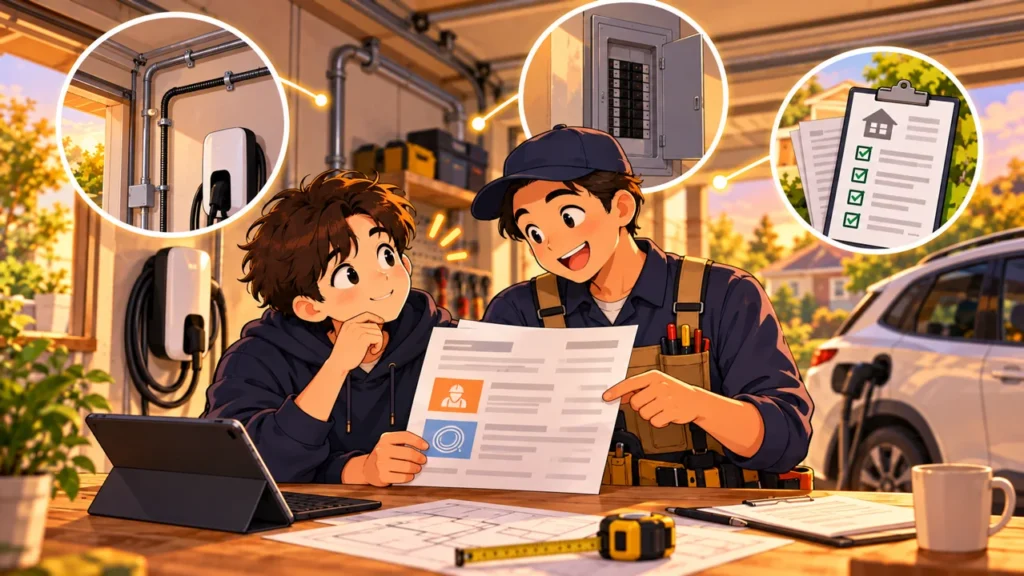
Compare EV charger installation cost using the complete price for the same charging output and work scope. A headline installation figure may exclude your charging unit, permits or additional electrical work—or include some of them. Establish those boundaries before deciding whether a quote is expensive.
Qmerit Installation Cost: What Does the $1,700 Benchmark Include?
Published 2026 installation figures range from $749 to $2,500, with a reported average around $1,700. Treat this as one installation network’s reference, not a nationwide price guarantee or a cap on your project.
Do not assume $1,700 means electrical work only. The same cost guide also gives an illustrative $1,700 project made up of $800 for charging equipment, $600 for labor and permitting, and $300 for electrical materials. That example includes hardware; it does not establish the contents of every actual quote.
A separate installation-components guide uses a broader $749-to-$3,000-plus figure. Those published figures do not define an identical package. Your written proposal must establish whether the unit, circuit, permits, panel work and restoration are included.
Is a Qmerit Quote Above $1,700 Too High?
A higher quote needs a scope comparison, not an automatic rejection. Ask the installer to identify the wiring route, charging output, exact equipment and each additional task. A short garage circuit and a detached-garage installation requiring trenching are different jobs.
| Quote item | What to confirm before comparing |
|---|---|
| Charging equipment | Exact model; supplied by you or included by the installer |
| Dedicated circuit | Charging output, route, installation labor and materials |
| Permits and inspection | Fees and responsibility included or excluded |
| Additional work | Panel/service changes, trenching and restoration priced separately |
| Change orders | What site findings can increase the agreed amount |
If an upgrade is proposed, request its load-calculation basis and whether an appropriate lower charging setting or compatible load management was evaluated. The qualified installer must determine which options are acceptable.
What Makes an EV Charger Installation More Expensive?
1. Distance from the electrical panel
A charger mounted near the panel may require a short, accessible wiring route. A parking space across a finished basement, driveway or detached garage can require more conductors, conduit, wall repair or excavation. Request the actual wiring route.
2. Available service and panel capacity
A panel with open breaker spaces is not necessarily able to support another continuous load. A qualified electrician should review the service, existing household loads, and the proposed charging setting. Load management or lower charging current may avoid costly upgrades. See our 200-amp service and EV charging guide.
3. Plug-in versus hardwired equipment
A plug-in installation and a hardwired installation can have different outlet, GFCI protection, conductor, and equipment requirements under the locally adopted code and manufacturer instructions. Do not assume an existing range or dryer receptacle is approved for regular EV charging. The cheapest option may not be compliant.
4. Permit, outdoor installation, and restoration
Exterior mounting, trenching, masonry penetrations, weather-rated equipment, permit fees and post-installation testing can change the final invoice. Confirm who pays for permits and restoration.
Considering an existing laundry circuit instead? Our dryer outlet EV charging guide compares 14-30 and 10-30 connections, supported charging equipment and the checks needed before assuming a new circuit can be avoided.
Related reading: hardwired vs plug-in EV charger installation.
32A, 40A, or 48A Charging: Why Circuit Size Matters
At a nominal 240 volts, common Level 2 settings have different power and circuit requirements. These are examples, not electrical designs:
| EV charging output | Nominal charging power | Common circuit-breaker rating |
|---|---|---|
| 32A | 7.68 kW | 40A |
| 40A | 9.60 kW | 50A |
| 48A | 11.52 kW | 60A |
The breaker rating is not the charging output. Actual charging speed depends on the vehicle and installation. Higher output is not always worth the extra cost. A licensed electrician must determine conductor sizing, protective devices, equipment compatibility, and applicable code requirements.
Related reading: 32A vs 48A EV charging speed; monthly home EV charging cost.
A $1,350 Quote vs a $2,100 Quote: Add the Missing Items
These hypothetical amounts are arithmetic examples, not market prices. Assume both proposals provide the same suitable 32A hardwired installation, equipment model and short wiring route, with no panel work required.
| Comparable scope item | Quote A | Quote B |
|---|---|---|
| Quoted circuit installation | $1,350 | Included below |
| Same charging unit | $500 separately | Included |
| Same permits and inspection | $150 separately | Included |
| Additional work in this example | None | None |
| Complete comparable total | $2,000 | $2,100 |
Quote A’s comparable total is $1,350 + $500 + $150 = $2,000. The difference is $100, rather than the $750 gap between the headline prices. Confirm taxes and all other exclusions before treating either amount as final.
If the proposals use different charging currents, routes or equipment, request an equivalent alternative rather than assigning an invented price to the difference. Use the EV Charger Quote Checker to organize up to three proposals; it does not certify local pricing or code compliance.
Does Your Home Need a Panel Upgrade?
Not every 100A or 125A home needs a 200A service upgrade for Level 2 charging, and a 200A home is not automatically ready for 48A charging. The decision comes from a load calculation, equipment condition, installation constraints, and the locally adopted requirements.
Our home EV charger electrical installation checklist covers the service, circuit and wiring questions that should be settled before accepting a proposal.
EV Charger Tax Credits and Rebates in Late 2026
Important 2026 update: The federal Section 30C alternative-fuel refueling property credit ended for charging property placed in service after June 30, 2026. Do not subtract a federal 30% charger-installation credit from a new October 2026 project estimate. Earlier qualifying installations had location and other eligibility requirements. State, local and utility incentives may still exist; verify current eligibility directly before budgeting any rebate.
Related reading: PSE EV charger rebate eligibility.
Questions to Ask Before Hiring an EV Charger Installer
- Is charging equipment included, and which exact model will be installed?
- What charging current, breaker rating, and wiring route are proposed?
- Was a service load calculation performed, and is load management an option?
- Are permits, inspection, trenching, repairs, and taxes included?
- What conditions would trigger a change order or additional panel expense?
Frequently Asked Questions
Is a Level 2 charger cheaper to install near the electrical panel?
Often, because a shorter accessible route generally needs less labor and material. Other site conditions can outweigh distance.
Can I install a 48A EV charger on a 50A circuit?
Do not equate the charging output with circuit rating. A common manufacturer configuration pairs 48A charging with a 60A circuit; the electrician must check the specific listed equipment and local requirements.
Which home EV charger should I buy before installation?
Choose equipment based on vehicle compatibility, required charging output, connector, warranty, and approved installation method—not advertised amperage alone. Our Emporia versus ChargePoint Home Flex comparison discusses practical differences.
Bottom Line
Compare written quotes for the same charging output and work scope, with separate equipment, electrical work, permits and upgrade costs.
Official References and Cost Sources
- 2026 Level 2 installation cost data — Qmerit
- What a home EV charger installation quote includes — Qmerit
- Wall Connector circuit and charging-current examples — Tesla
- Section 30C home charging tax-credit eligibility — IRS
- EV charging infrastructure planning — U.S. Department of Energy, AFDC
About the author: JHOTAS-LAB is written by an electrical-construction practitioner based in South Korea. U.S. electrical designs, permits and installation costs must be verified with qualified local professionals.
Is there something you’d like to see?
Suggest an electrical topic, practical guide, or calculator you would like to see on JHOTAS-LAB. Your suggestion may help shape future content.


