
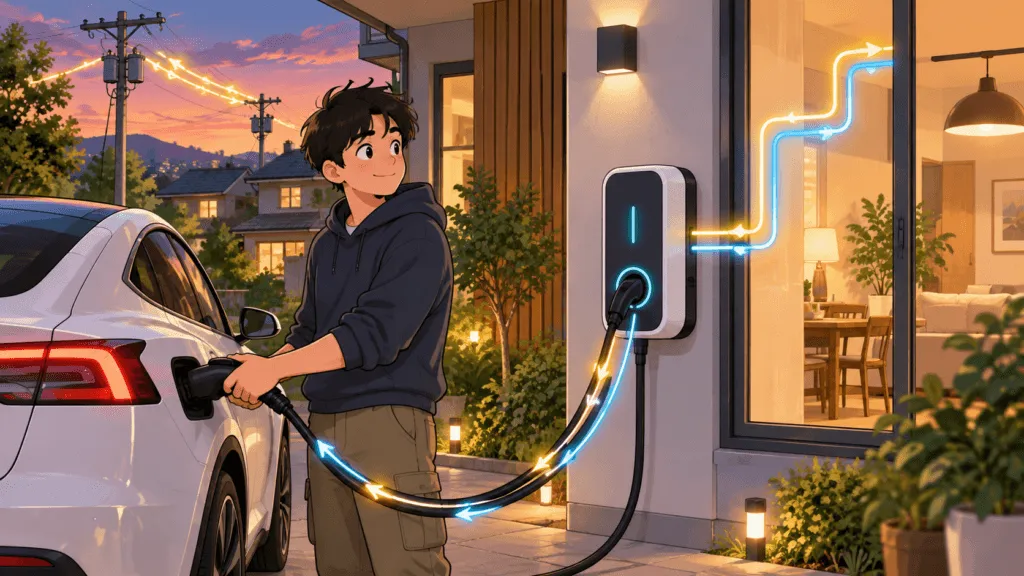
Vehicle-to-grid charging moved a step closer to wider commercial use in the United States on September 14, 2026.
UL Solutions launched a new certification program for AC bidirectional EV charging equipment based on the recently published UL 1741 Supplement SC.
The program gives manufacturers a formal way to test and certify equipment that allows a compatible electric vehicle to send electricity back to the power grid.
That does not mean every EV can suddenly operate as a grid battery.
But it removes one important technical and certification barrier for manufacturers developing vehicle-to-grid charging systems.
What Is Vehicle-to-Grid Charging?
Most EV charging works in one direction.
Electricity flows:
Grid → charger → EV battery
Vehicle-to-grid, or V2G, allows electricity to move in both directions.
A compatible EV can charge when electricity is available and later send part of its stored energy back to the grid when needed.
This is different from simply using an EV as emergency backup power.
V2H, or vehicle-to-home, generally refers to using an EV battery to supply a house.
V2G specifically involves interaction with the utility grid.
In practice, one system may eventually support several of these functions, but the electrical and interconnection requirements are not identical.
Related reading: Tesla Powerwall virtual power plants.
What Did UL Solutions Announce?
UL Solutions’ new program allows products to be evaluated under UL 1741 Supplement SC.
UL 1741 is the standard covering inverters, converters, controllers and interconnection equipment used with distributed energy resources.
Supplement SC specifically addresses bidirectional EV supply equipment and interconnection equipment used with EVs that contain onboard bidirectional inverters.
That last part is important.
In this type of AC V2G system, the vehicle itself contains the bidirectional inverter needed to convert energy from the battery into AC electricity suitable for grid interaction.
The charging equipment still plays an important role in communication, protection and interconnection, but the main bidirectional inverter is onboard the vehicle.
UL says vehicles used with this certification approach can use onboard inverter systems designed and tested in accordance with SAE J3072.
Why Certification Matters for V2G
Sending electricity into the grid is very different from simply charging a battery.
A grid-connected power source has to behave correctly when voltage or frequency changes.
It also needs appropriate protection and control behavior.
Utilities need confidence that connected equipment will not continue energizing part of the electrical system when it should disconnect, and that it can meet applicable grid-support requirements.
UL 1741 already plays an important role in certification for equipment such as solar and battery inverters.
Applying a dedicated supplement to AC V2G gives manufacturers a clearer certification path for vehicles and charging equipment that can export power.
This certification does not automatically guarantee approval from every utility.
Local utilities, grid codes and authorities having jurisdiction can still have their own interconnection requirements.
But standardized testing gives those parties a common technical basis when evaluating new equipment.
AC V2G Is Different From DC Bidirectional Charging
Bidirectional charging is not one single architecture.
With an AC V2G system, the EV contains the bidirectional inverter.
The battery stores DC electricity, while the onboard inverter handles the conversion required to interact with the AC grid.
In other systems, power conversion can take place outside the vehicle.
UL Solutions says offboard electric vehicle power export equipment can also be evaluated using UL 9741, together with relevant UL 1741 grid-interconnection requirements.
So the new Supplement SC is important because it provides a dedicated path for the onboard-inverter AC architecture.
That could give automakers more flexibility in how V2G systems are designed.
Why Utilities Are Interested in EV Batteries
Electric vehicles contain large batteries that spend much of their time parked.
UL Solutions cited research indicating that roughly 90% of EVs are parked at any given time under typical driving patterns.
That creates a large amount of battery capacity that could potentially remain connected to the grid for many hours each day.
A utility could potentially use participating EVs to help during periods of:
- high electricity demand,
- renewable-energy fluctuations,
- local grid constraints,
- or other periods when additional flexibility is valuable.
This does not mean utilities can simply drain EV batteries whenever they want.
Actual programs would need rules for battery state of charge, customer participation, compensation, vehicle availability and battery warranty.
But technically, a parked EV fleet could behave like a large group of distributed batteries.
👉 For context on why flexible storage is becoming more valuable to the U.S. grid, see[Why Is Battery Energy Storage Growing So Fast in the U.S.?].”
Could an EV Really Become Part of a Home Energy System?
Potentially, yes.
A vehicle with a sufficiently large battery can hold far more energy than many residential stationary batteries.
That makes bidirectional EV charging attractive for homeowners interested in backup power.
But installing a bidirectional charger is not necessarily the same as replacing an ordinary Level 2 EV charger.
The electrical system may need additional equipment for isolation, protection, transfer functions and interconnection.
Existing service capacity and panel configuration also matter.
👉 If you’re already considering home EV charging, [Do You Need an Electrical Panel Upgrade?] explains why service capacity and load calculations should be checked before adding large electrical loads.
For V2G, utility approval becomes even more important because the vehicle is no longer only a load.
It can also become a source of electricity.
Certification Does Not Mean V2G Is Ready Everywhere
The September announcement is an important technical step, but it should not be interpreted as nationwide V2G availability.
A complete V2G system still requires several pieces to work together:
compatible EV hardware, a bidirectional charging system, software and communication, utility interconnection approval, and an electricity program that actually allows the vehicle to participate.
Vehicle manufacturers also have to decide which models will support bidirectional operation and under what warranty conditions.
Utilities must decide how participating vehicles will be controlled and compensated.
Certification helps standardize one important part of that chain.
It does not solve every market or regulatory issue.
My View From the Electrical Construction Side
From an electrical construction perspective, V2G is interesting because an EV charger stops being only a load.
Once power can flow in both directions, the installation starts to resemble a small distributed energy resource.
Protection, isolation, inverter behavior, communications and utility interconnection become much more important.
That is why certification standards matter.
A bidirectional EV may look simple from the driver’s side: plug in the vehicle and choose when to charge or discharge.
Behind that interface, the electrical system has to control power flow safely between the battery, the building and potentially the utility grid.
Final Thoughts
UL Solutions’ new certification program does not make V2G universal overnight.
What it does provide is a clearer certification path for AC bidirectional charging systems that use EVs with onboard bidirectional inverters.
That matters because manufacturers now have a defined way to demonstrate safety and grid-interconnection performance under UL 1741 Supplement SC.
V2G still depends on compatible vehicles, utility programs, interconnection rules and customer economics.
But standardizing how the equipment is tested is a practical step toward making bidirectional EV charging easier to deploy at larger scale.
Sources & Official References
This article was researched using UL Solutions materials on its September 14, 2026 V2G certification announcement, UL 1741 Supplement SC, UL 9741 and bidirectional EV charging standards.
UL Solutions — September 14, 2026 Vehicle-to-Grid Certification Program Announcement
https://www.ul.com/news/ul-solutions-launches-certification-program-help-electric-vehicles-support-power-grid
UL Solutions — Distributed Energy Resource Testing and UL 1741
https://www.ul.com/services/distributed-energy-resource-testing
UL Solutions — Bidirectional EV Charging and V2G Standards
https://www.ul.com/insights/strategies-proactively-tackle-bidirectional-charging
UL Solutions — V2G and EV Power Export Equipment
https://www.ul.com/resources/v2g-and-evpe-market-access-bidirectional-ev-chargers
UL Solutions — Electric Vehicle Charging Infrastructure Services
https://www.ul.com/services/electric-vehicle-ev-charging-infrastructure-services
Sources checked September 15, 2026.
Is there something you’d like to see?
Suggest an electrical topic, practical guide, or calculator you would like to see on JHOTAS-LAB. Your suggestion may help shape future content.


