
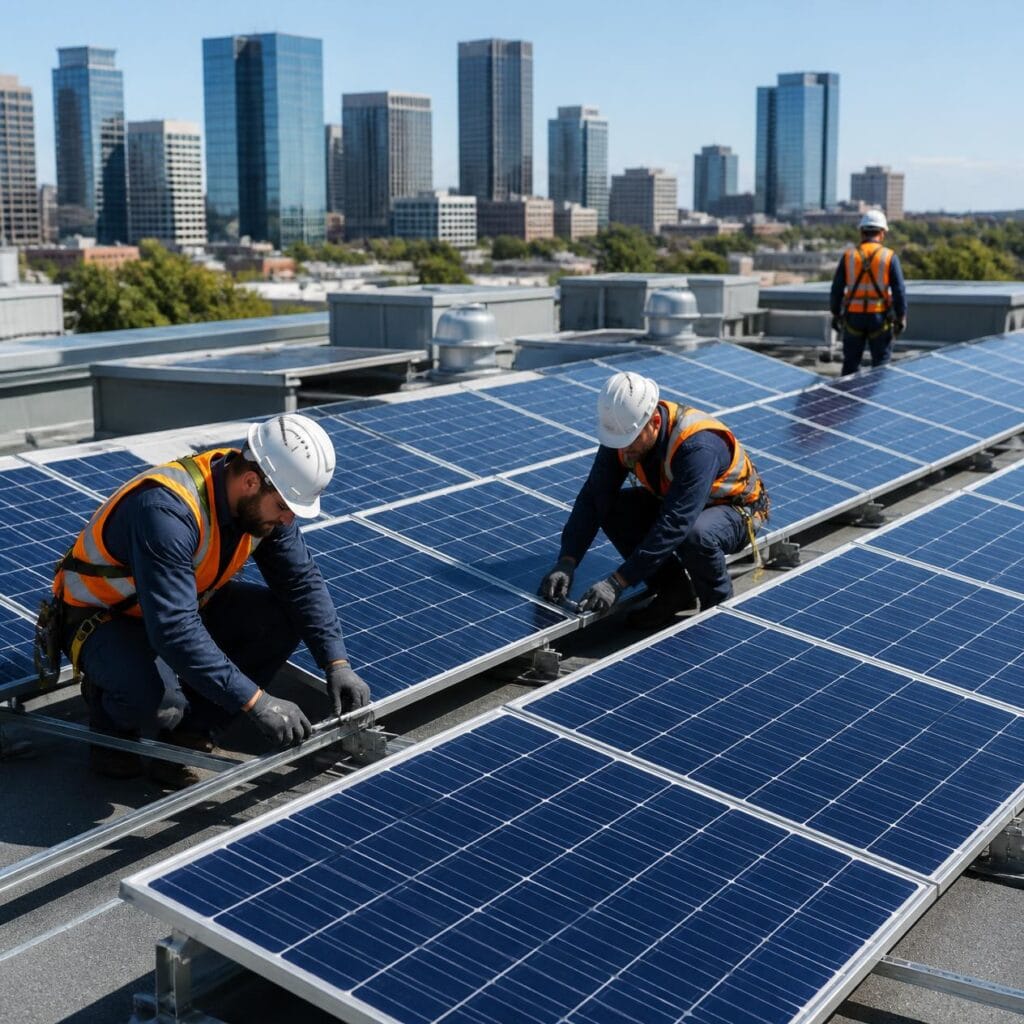
Selecting the right partner among hundreds of commercial solar companies is single-handedly the most critical factor determining your facility’s long-term solar Return on Investment (ROI), warranty coverage, and grid interconnection speed.
Unlike residential installations, commercial-scale solar projects require specialized structural engineering, high-voltage electrical expertise, and complex navigation of federal, state, and utility incentives.
This 2026 guide breaks down the essential benchmarks for evaluating commercial solar contractors, key red flags to avoid, and financial structures that maximize net operational savings.
💡 Executive Summary: Contractor Selection Checklist & Benchmarks
For corporate leaders and facility managers needing immediate key evaluation metrics, below is a quick-reference benchmark matrix:
+------------------------------------+-----------------------------------------------------+
| Evaluation Metric                  | Industry Standard / Benchmark                       |
+------------------------------------+-----------------------------------------------------+
| Engineering Credentials            | In-house NABCEP-certified design team                |
| Target Portfolio Range             | 50 kW to 1 MW+ verified commercial case studies     |
| Structural / Roof Warranty         | 25-Year performance & workmanship warranty          |
| Key Financial Modeling             | Includes 30% Federal ITC, MACRS & demand charges    |
| Average Project Timeline           | 3 to 6 Months (Engineering, Permitting to PTO)      |
+------------------------------------+-----------------------------------------------------+
- Bottom Line: The top commercial solar companies differentiate themselves not by lower equipment prices, but by in-house engineering capabilities, transparent cash-flow modeling, and seamless utility interconnection management.
📋 4 Essential Criteria to Evaluate Commercial Solar Companies
When vetting prospective commercial solar contractors, look beyond gross quote estimates and evaluate these four structural pillars:
1. In-House NABCEP Engineering vs. Subcontracted Labor
Top-tier contractors retain in-house North American Board of Certified Energy Practitioners (NABCEP) engineers and licensed master electricians. Companies that rely heavily on third-party sub-contractors often experience communication bottlenecks, permitting delays, and split warranty accountability.
2. Comprehensive Utility Interconnection Experience
Navigating local utility grid capacities (e.g., PG&E, ConEd, ComEd) is frequently the biggest bottleneck in commercial solar timelines. Experienced commercial installers maintain established workflows with regional grid operators to secure Permission to Operate (PTO) without months of idling.
3. Financial Modeling & Tax Credit Optimization
Top commercial solar companies provide audit-ready financial models that incorporate:
- 30% Federal Investment Tax Credit (ITC) plus qualifying regional bonus adders.
- MACRS 5-Year Accelerated Depreciation tax benefits.
- Peak Demand Charge Reductions achieved via integrated battery energy storage systems (BESS).
4. Roof & Structural Integrity Guarantees
Commercial solar arrays add dead-weight loads and wind-uplift pressures to building envelopes. Reputable installers collaborate directly with your commercial roofing manufacturer to install certified non-penetrating ballast mounts or flashings that keep existing roof warranties intact.
💳 Comparing Funding Models Offered by Solar Companies
Leading commercial solar companies typically offer three primary project financing pathways:
+--------------------------+---------------------------------+---------------------------------+
| Financing Option         | Asset Ownership                 | Financial Impact                |
+--------------------------+---------------------------------+---------------------------------+
| Cash Purchase            | 100% Owned by Your Business     | Highest lifetime ROI & tax credits |
| Commercial Solar Loan    | Owned by Your Business          | $0-Down options; cash-flow positive |
| Power Purchase Agreement | Owned by Third-Party Developer  | Off-balance-sheet; zero CapEx   |
+--------------------------+---------------------------------+---------------------------------+
❓ Frequently Asked Questions (FAQ)
How do I verify a commercial solar company’s track record?
Ask for at least three commercial case studies within your industry or geographic region, and request references from facility managers regarding project completion timelines and post-installation Operation & Maintenance (O&M) responsiveness.
How long does a commercial solar project take from contract to turn-on?
While physical roof/ground construction takes only 2 to 4 weeks, the entire end-to-end process—including structural engineering, municipal permitting, equipment procurement, and utility PTO approval—typically takes 3 to 6 months.
🎯 Conclusion: Final Contractor Recommendation
Partnering with the right commercial solar company transforms an unpredictable utility expense into a high-yielding, self-amortizing asset. Prioritize established contractors with in-house NABCEP credentials, proven local utility experience, and long-term warranty backed service agreements to secure your organization’s energy independence in 2026.