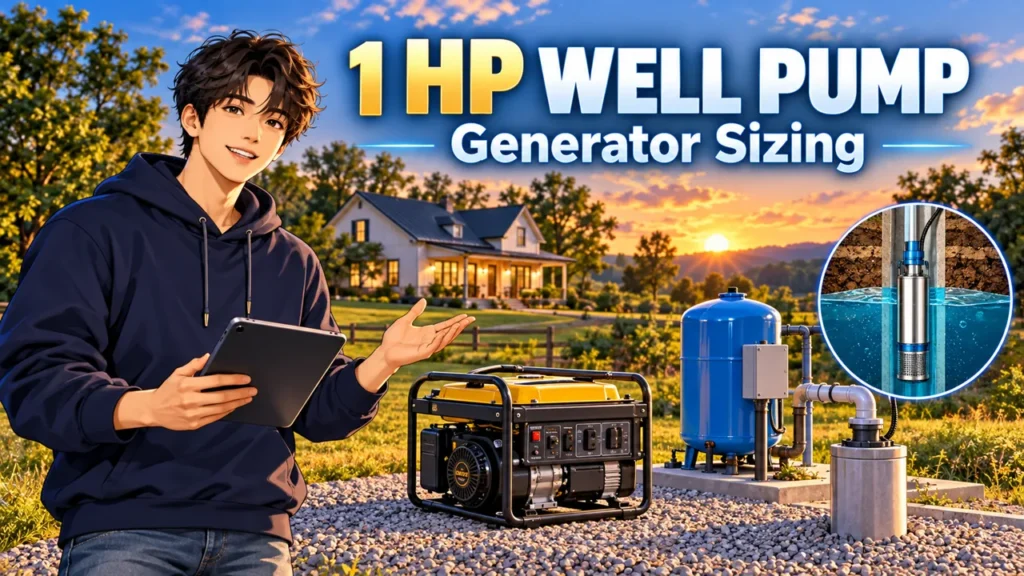
What size generator do you need for a 1 HP well pump? In many cases, the answer is larger than the pump’s normal running watts suggest because a well pump is a motor load with a short but significant starting surge.
A 1 HP pump is not simply a 746-watt load. Motor efficiency, power factor, voltage, and starting current all matter. That is why generator sizing should start from the pump nameplate or manufacturer data—not horsepower alone.
Why 1 HP Does Not Mean 746 Watts From the Generator
One mechanical horsepower equals about 746 watts, but a motor must draw more electrical input than the mechanical power it delivers. A pump motor also has reactive current and losses.
A 1 HP submersible well pump may therefore draw several hundred watts more than 746W while running and several times that amount during startup.
Check Voltage First: Many 1 HP Well Pumps Are 240V
Many residential 1 HP well pumps use 230/240V power. That means a 120V-only portable generator cannot run the pump even if its wattage rating looks large enough.
Before comparing generator sizes, check the pump controller, pressure-switch circuit, and motor nameplate for the actual voltage requirement.
Running Watts vs. Starting Watts
Running watts are what the pump needs after the motor reaches normal speed. Starting watts are the short-duration power needed while the motor accelerates.
If an illustrative 1 HP pump draws 8A at 240V while running, the apparent running load is about:
240V × 8A = 1,920 VA
If the starting current momentarily rises to 4 times the running current, the generator may need to support roughly 7.7 kVA during the start.
This is only an example. Actual starting current can differ widely by pump, motor design, control system, and supply conditions.
A Practical Generator Sizing Example
| Load | Illustrative running power | Illustrative starting requirement |
|---|---|---|
| 1 HP well pump | 1.8–2.0 kW | 5–8 kVA range |
| Refrigerator | 150 W | 1,000+ W surge possible |
| Lights + Wi-Fi | 100–200 W | Minimal surge |
A homeowner running only the well pump may need a smaller generator than someone who wants the pump, refrigerator, furnace blower, lights, and microwave available at the same time.
Do You Add Every Starting Surge Together?
Usually, you size for the realistic worst-case sequence rather than assuming every motor starts at the same millisecond. If the well pump is the largest motor, it often drives the generator surge requirement.
Load management can make a major difference. Avoiding the microwave or electric water heater while the pump starts can reduce the generator size needed.
→ Related Guide: What Size Generator for a Refrigerator, Lights, Wi-Fi and TV?
For the same distinction in a larger backup-power setting, see Data Center UPS kVA vs. kW: Sizing and Power Factor. UPS sizing is not interchangeable with generator motor-start sizing.
Why Generator kW and kVA Both Matter for Motors
A generator has to provide both real power and the current associated with motor starting. A motor with poor power factor during startup can require much more apparent power than its normal running kW.
That is why a generator’s surge rating and motor-start capability can be more important than its continuous wattage when sizing for a well pump.
Voltage Drop Can Make Starting Harder
Long extension cords, undersized conductors, weak connections, or a generator operating near its limit can reduce voltage at the pump. Lower voltage can make a motor take longer to accelerate, increasing current and making the starting event even harder.
For a fixed well-pump circuit, use a proper transfer arrangement and wiring method rather than improvised backfeeding.
What Size Generator Is a Reasonable Starting Range?
For many 1 HP well-pump installations, homeowners end up looking at 240V generators in roughly the mid-single-digit kW class or larger because of motor starting requirements and other household loads. But there is no universal wattage that fits every 1 HP pump.
The correct answer comes from the pump’s running amps, locked-rotor or starting data, generator surge capability, and the other loads you plan to operate.
Generator Safety
Portable generators produce carbon monoxide. Operate them outdoors, well away from doors, windows, and vents, and follow the generator manufacturer’s placement and ventilation instructions.
Never connect a portable generator to home wiring through an improvised male-to-male cord. Permanent connections require an approved transfer or interlock system appropriate for the installation.
→ Related Guide: Solar Battery vs Generator: Which Is Better for Home Backup?
Bottom Line
A 1 HP well pump can require a generator much larger than its running watts suggest because the motor needs a strong starting surge and often runs at 240V.
Check the pump nameplate, controller data, voltage, and starting current first. Then size the generator for the pump start plus the other loads that may already be running.
About the author
I have practical experience in electrical construction and electrical project coordination in South Korea. For U.S.-focused guides, I research official codes, government data, utility documents, and manufacturer specifications to explain electrical and energy topics as accurately and practically as possible.
Sources & Official References
- U.S. Consumer Product Safety Commission — Carbon Monoxide Information Center
- Franklin Electric — Water Systems Resources
Is there something you’d like to see?
Suggest an electrical topic, practical guide, or calculator you would like to see on JHOTAS-LAB. Your suggestion may help shape future content.