
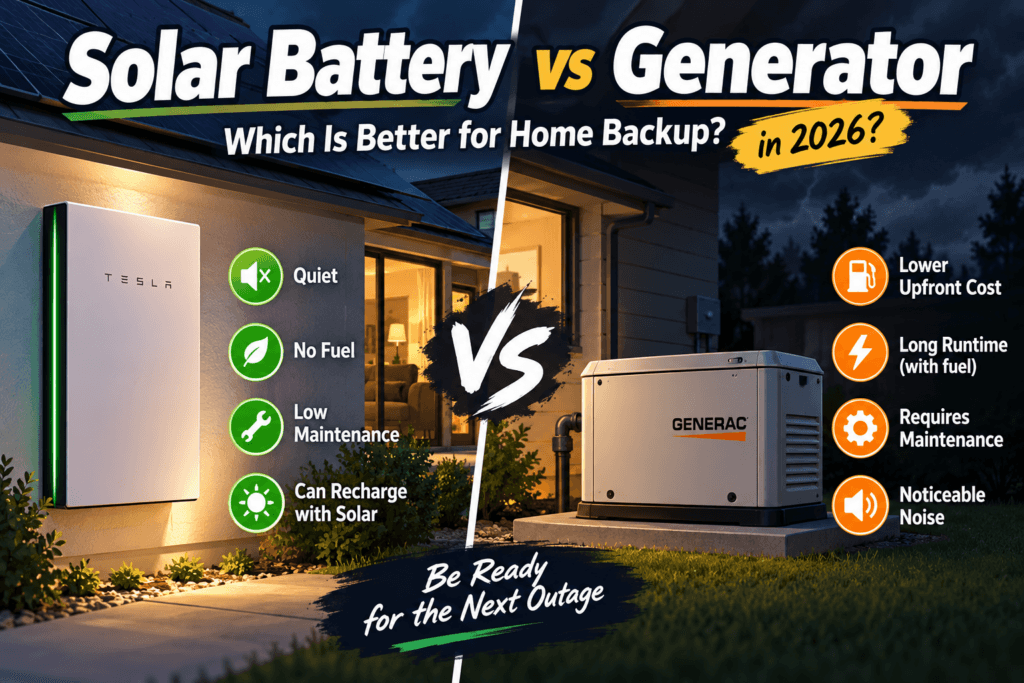
A generator is usually cheaper upfront and can provide long-duration backup as long as fuel is available. A solar battery is quieter, requires less routine maintenance, and can be recharged by solar panels—but it costs considerably more upfront.
For many homeowners, the choice comes down to what matters more:
Lower upfront cost and long outage runtime → generator
Quiet automatic backup + solar integration + everyday energy use → battery
In 2026, EnergySage estimates a typical standby generator installation at around $7,000, while a typical 13.5 kWh home battery costs about $15,650 before available state or utility incentives.
So batteries are still the more expensive option initially.
But price alone does not tell the whole story.
Solar Battery vs Generator: Quick Comparison
| Feature | Solar Battery | Generator |
|---|---|---|
| Typical upfront cost | ~$15,650 | ~$7,000 |
| Fuel required | No | Yes |
| Noise | Very low | Noticeable |
| Routine maintenance | Relatively low | Required |
| Works at night | Yes, until discharged | Yes, with fuel |
| Can recharge from solar | Yes | No |
| Long outage capability | Depends on battery + solar | Strong if fuel continues |
| Everyday energy use | Possible | Usually outage-only |
| Local emissions | None during operation | Yes |
| Federal homeowner credit in 2026 | No | No |
The right choice depends heavily on how long your outages last and what you want to keep running.
How Much Does a Solar Battery Cost in 2026?
A typical home battery installation costs approximately $15,647 for about 13.5 kWh of storage in 2026, according to EnergySage marketplace data.
That amount of storage may be enough for essential loads such as:
- Refrigerator
- Lights
- Wi-Fi
- Selected outlets
- Medical equipment
But it does not necessarily mean the entire house can operate normally for a full day.
Large electrical loads such as central air conditioning, electric water heating, cooking equipment, dryers, and EV charging can drain a battery much faster.
Whole-home battery backup may therefore require two or more batteries.
How Much Does a Generator Cost?
EnergySage estimates that installing a generator capable of home backup typically costs around $7,000, though actual pricing varies significantly based on generator size, fuel type, electrical work, and installation.
Generators therefore have a major advantage:
lower upfront cost.
A natural-gas or propane standby generator can also continue operating for a long outage as long as its fuel supply remains available.
That makes generators particularly attractive in areas where hurricanes, winter storms, or other events can knock out electricity for several days.
Which One Lasts Longer During an Outage?
A generator generally wins if the question is simply:
“How long can I keep producing electricity?”
If fuel is available, a generator can continue running.
A battery has a fixed amount of stored energy.
For example, a 13.5 kWh battery cannot indefinitely supply a house consuming several kilowatts continuously.
But solar changes the comparison.
With a properly configured solar-plus-battery system, rooftop panels can:
power loads during daylight → recharge the battery → battery supplies power later
That can substantially extend backup time.
The Department of Energy explains that solar-plus-storage systems can continue supplying power during outages when designed to safely disconnect from the utility grid.
So during a long sunny outage, a solar battery can potentially recharge every day.
A standalone battery cannot.
Which Is Better for Air Conditioning?
This is where homeowners need to look beyond battery capacity.
Starting and operating a large central air conditioner requires significant power.
A battery system must have enough:
energy capacity in kWh + inverter output in kW
to support the equipment.
Running central AC for hours can require multiple batteries depending on the system.
A properly sized standby generator can often support large loads more easily, which is one reason generators remain popular for whole-home backup.
If your goal is only to operate a refrigerator, lights, internet, and a few outlets, a battery becomes much easier to size economically.
Batteries Are Much Quieter
This difference is obvious once the equipment starts operating.
A home battery contains no combustion engine.
It operates quietly.
A generator burns gasoline, propane, diesel, or natural gas and produces mechanical and exhaust noise.
For occasional emergency operation, that may be perfectly acceptable.
But homeowners living close to neighbors—or anyone wanting silent overnight backup—may strongly prefer batteries.
Generators Require Fuel and Maintenance
Generators contain engines.
That means they typically require periodic servicing, testing, oil changes, and other maintenance depending on the equipment.
They also rely on a fuel supply.
Portable generators introduce an additional safety consideration: carbon monoxide.
The U.S. Consumer Product Safety Commission warns that generator exhaust can cause fatal CO poisoning and says portable generators must be operated outdoors, at least 20 feet away from the home, with exhaust directed away from buildings.
A permanently installed standby generator has a very different setup from a portable generator, but combustion, exhaust, and maintenance still remain part of the system.
Battery storage avoids those fuel-related issues during operation.
A Battery Can Do Something a Generator Usually Cannot
A generator normally sits unused until the grid fails.
A battery can potentially provide value every day.
Depending on utility rates and programs, homeowners may use batteries to:
- Store excess solar
- Reduce grid purchases during peak rates
- Increase solar self-consumption
- Participate in virtual power plant programs
- Provide backup during outages
That means a battery can act as both energy-management equipment and emergency backup.
A generator is primarily backup equipment.
This distinction can help justify the higher battery price in certain utility markets.
What About the Federal Battery Tax Credit?
This changed significantly in 2026.
Battery storage previously qualified for the federal Residential Clean Energy Credit.
But the IRS states that the Section 25D credit cannot be claimed for residential clean-energy expenditures made after December 31, 2025.
So a homeowner installing a new battery in 2026 should not automatically subtract 30% from the price based on older articles.
State, local, and utility battery incentives may still exist, so they should be checked separately.
When I Would Choose a Generator
A generator may make more sense if:
- Long multi-day outages are common
- You want whole-home backup
- You have reliable natural-gas or propane access
- Large loads such as central AC are important
- Upfront cost is a major concern
- You do not already have solar
For pure emergency power per dollar, generators remain extremely competitive.
When I Would Choose a Solar Battery
A battery may make more sense if:
- Outages are usually short
- Quiet operation matters
- You already have solar
- You want to recharge from solar during outages
- Your utility has expensive peak rates
- Export compensation for solar is poor
- You value low-maintenance automatic backup
Battery storage can also be attractive when only critical loads need backup rather than the entire house.
My View From the Electrical Construction Side
From an electrical construction perspective, I would not choose either system before identifying the backup loads.
Start by asking:
What absolutely needs electricity when the grid fails?
If the answer is:
fridge + Wi-Fi + lights + several outlets, a battery system may be relatively straightforward.
If the answer becomes:
central AC + water heater + range + dryer + entire house, the required electrical capacity changes dramatically.
The backup source is only one part of the project.
You also need to consider transfer equipment, breakers, panel configuration, wiring, inverter or generator output, and safe isolation from the utility grid.
Size the loads first. Choose the backup source second.
Final Answer: Solar Battery or Generator?
There is no universal winner.
For lowest upfront cost and long-duration whole-home backup, a generator is often difficult to beat.
For quiet operation, solar charging, lower routine maintenance, and everyday energy management, a home battery has major advantages.
And a third option is becoming increasingly attractive:
Solar + battery + generator
A battery handles short outages and everyday energy use quietly, while a generator becomes the fallback for exceptionally long outages.
For most homeowners, though, I would start by calculating the essential backup load and comparing the complete installed cost of both options.
That tells you far more than simply comparing the price of a battery box with the price of a generator.
Is there something you’d like to see?
Suggest an electrical topic, practical guide, or calculator you would like to see on JHOTAS-LAB. Your suggestion may help shape future content.