
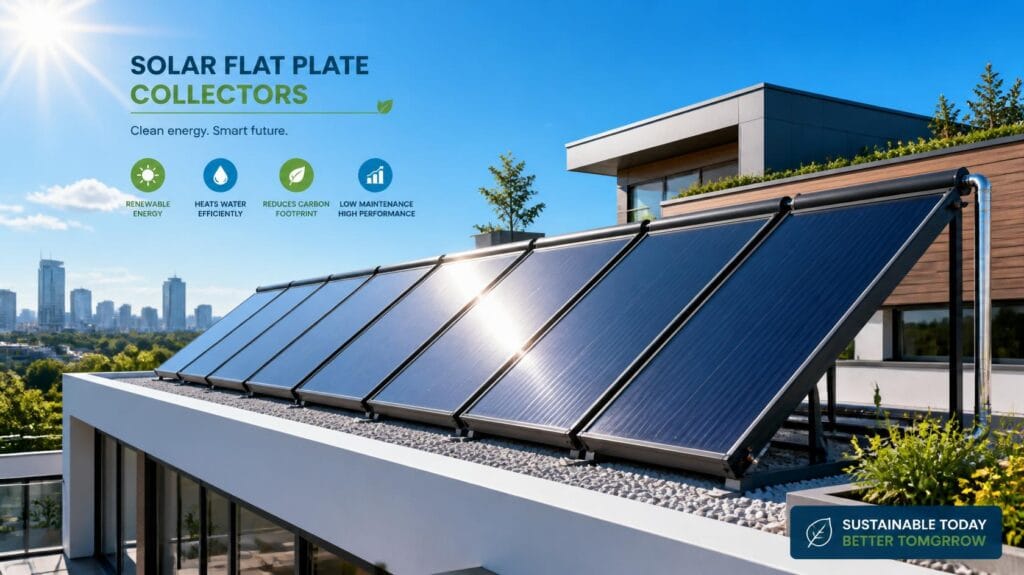
Evaluating solar thermal technology for residential hot water or commercial process heat requires navigating complex efficiency metrics and equipment quotes.
Below is the complete 2026 technical and financial breakdown for solar flat plate collectors, structured to help facility managers, engineers, and homeowners make an informed capital investment.
💡 Executive Summary: Key Takeaways & Cost Overview
For decision-makers requiring an immediate summary, flat plate collectors offer the highest structural durability and lowest lifetime maintenance per thermal unit generated in mild to warm climates.
+------------------------------------+-----------------------------------------------------+
| Metric                             | Benchmark Value (2026)                              |
+------------------------------------+-----------------------------------------------------+
| Average Thermal Efficiency         | 60% – 80% (Peak solar irradiance)                   |
| Estimated System Lifespan          | 20 to 25+ Years                                     |
| Gross Residential Cost (1-2 Units) | $3,500 – $7,000                                     |
| Gross Commercial Cost (Array)      | $15,000 – $50,000+                                  |
| Federal Tax Incentive (U.S.)       | 30% Investment Tax Credit (ITC)                     |
| Average Financial Payback          | 4 to 8 Years                                        |
+------------------------------------+-----------------------------------------------------+
- Bottom Line: If your facility is located in a temperate zone and requires a continuous supply of domestic hot water ($40^\circ\text{C}$ to $80^\circ\text{C}$), flat plate collectors deliver the most reliable, cost-effective return on investment (ROI).
⚙️ How a Solar Flat Plate Collector Works
A solar flat plate collector converts absorbed sunlight directly into thermal energy using circulating fluids.
Key Internal Components
- Glazing (Top Glass): Tempered, low-iron glass designed for maximum light transmission while insulating against wind and convective heat loss.
- Absorber Plate: A copper or aluminum sheet treated with a selective dark coating (titanium nitrite or black chrome) that maximizes heat absorption and minimizes radiative heat loss.
- Riser & Header Tubes: Heavy-gauge copper piping bonded to the absorber plate through which water or anti-freeze heat-transfer fluid circulates.
- Thermal Insulation: High-density polyurethane or mineral wool lining the back and sides to trap absorbed heat.
🔄 Flat Plate vs. Evacuated Tube Collectors
Choosing between flat plate and evacuated tube technologies comes down to ambient climate and target operating temperatures:
+--------------------------+---------------------------------+---------------------------------+
| Feature                  | Flat Plate Collector            | Evacuated Tube Collector        |
+--------------------------+---------------------------------+---------------------------------+
| Best Operating Climate   | Moderate to Warm Climates       | Freezing / Extreme Cold         |
| Structural Durability    | Extremely Rugged (Low break)    | Moderate (Vacuum glass tubes)   |
| Maintenance Requirements | Virtually Zero                  | Periodic tube replacement       |
| High Temp Efficiency     | Moderate                        | High                            |
| Roof Aesthetics          | Flush, streamlined profile      | Industrial rack assembly        |
+--------------------------+---------------------------------+---------------------------------+
📈 Real-World Performance & Cost Drivers
Maximizing output from a flat plate collector system depends on proper engineering and installation parameters:
- Tilt & Orientation: Mount collectors true south (in the Northern Hemisphere) at an angle equal to the installation site’s latitude $+ 10^\circ \text{ to } 15^\circ$ for optimal winter absorption.
- Closed-Loop Freeze Protection: In regions subject to occasional freezing, a closed-loop system utilizing non-toxic propylene glycol prevents pipe rupture.
- Utility Offsets: By replacing natural gas or electric water heating, commercial installations significantly reduce monthly operational utility overhead.
❓ Frequently Asked Questions (FAQ)
Can flat plate collectors generate electricity?
No. Flat plate collectors are solar thermal devices that generate hot water or heat transfer fluid. They do not generate electricity like photovoltaic (PV) solar panels.
Do flat plate collectors work on cloudy days?
Yes. While direct beam sunlight yields maximum efficiency, flat plate collectors continue to capture diffuse solar radiation on cloudy days, maintaining baseline pre-heating capability.
🎯 Conclusion: Final Financial Takeaway
A solar flat plate collector system remains the gold standard for low-temperature solar thermal applications. With a 30% federal tax credit reducing initial capital expenditure and an operational lifespan exceeding two decades, it transforms a recurring utility expense into a reliable, self-amortizing asset.