
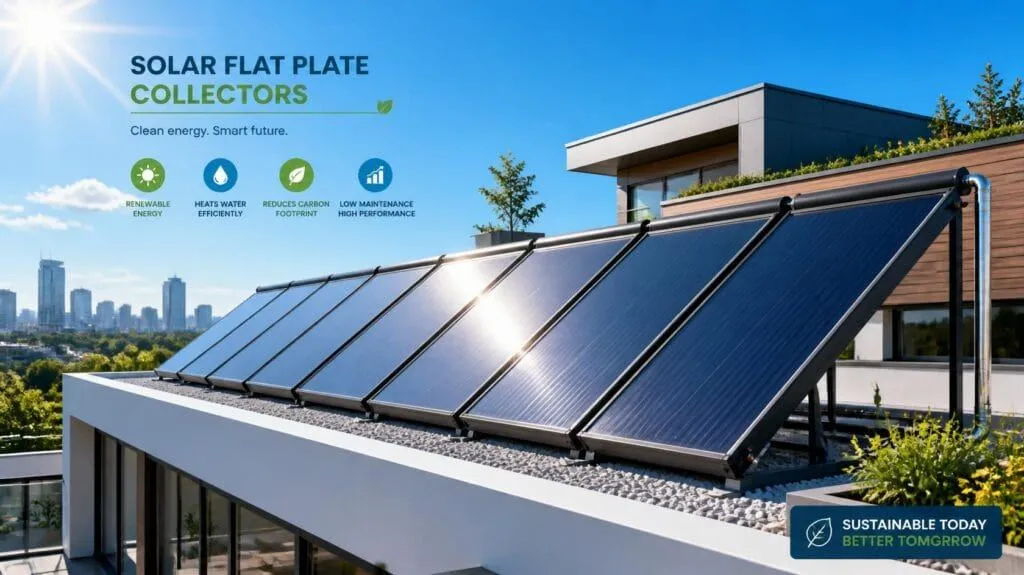
The flat plate solar collector market is part of the broader solar thermal industry, which continues to attract attention as countries look for lower-carbon ways to produce hot water, space heating, and industrial process heat.
Unlike solar photovoltaic panels, which generate electricity, flat plate solar collectors capture solar energy and convert it directly into usable heat.
For investors, however, there is an important distinction:
Many leading flat plate collector manufacturers are private companies, so there are relatively few pure-play flat plate solar collector stocks available on public markets.
This means investors interested in the sector may need to look not only at collector manufacturers, but also at larger heating, HVAC, renewable energy, and building-energy companies connected to the solar thermal market.
How Big Is the Solar Thermal Collector Market?
The exact market estimate varies considerably depending on how different research firms define solar thermal equipment.
Grand View Research estimated the global solar thermal collector market at $28.6 billion in 2023, with a projection of approximately $49.1 billion by 2030.
A more recent 2026 forecast from Fortune Business Insights estimates the broader solar thermal market at approximately $19.56 billion in 2026, with projected growth to around $42.56 billion by 2034.
The different estimates are a good reminder that market-size numbers should not be treated as exact figures. Neither headline value measures only flat-plate collectors: the two studies cover broader solar thermal market definitions and different forecast periods, so they cannot be compared as if they were competing estimates of one identical market.
However, the broader trend across these reports is similar: solar thermal remains an active renewable-heating market rather than a disappearing technology.
Why Are Flat Plate Solar Collectors Still Relevant?
Solar thermal and solar photovoltaic (PV) systems answer different customer questions. Flat-plate thermal collectors deliver heat, not grid-connected kilowatt-hours. If you are comparing how collectors work, see our flat-plate solar collector technical guide. For photovoltaic equipment and residential electrical installation costs, see our separate 2026 solar panel cost guide. The market figures below should not be used as an estimate of residential PV panel sales.
Flat plate collectors are relatively simple systems.
They normally consist of an absorber plate, transparent cover, insulation and tubes carrying a heat-transfer fluid.
Their biggest use cases include:
- Domestic hot water
- Commercial hot-water systems
- Space heating
- District heating
- Industrial process heat
Recent market research continues to list flat plate collectors as one of the main solar thermal collector categories alongside evacuated tube and other collector types.
Their mature design, relatively straightforward maintenance and ability to operate effectively at moderate temperatures continue to make them useful in many applications.
Major Flat Plate Solar Collector Companies
Several manufacturers appear repeatedly in current solar thermal market reports.
GREENoneTEC
GREENoneTEC is one of the best-known names in the flat plate collector industry and is frequently identified among the leading solar thermal collector manufacturers.
The company focuses heavily on solar thermal collector manufacturing and is particularly relevant when researching the flat plate collector supply chain.
However, it is not an obvious pure-play public stock for ordinary investors.
Viessmann
Viessmann has long operated across heating technologies, including solar thermal systems and flat plate collectors.
The company represents an important example of how solar thermal technology often sits inside a much larger heating and building-energy business rather than operating as an independent industry.
Sunrain
Sunrain is another frequently mentioned manufacturer in solar thermal industry research.
Recent market analysis has highlighted larger flat plate collector formats intended for commercial and higher-capacity installations.
Ariston
Ariston is also commonly included among major companies in the solar thermal collector industry.
Rather than being focused only on solar collectors, the company operates across a wider range of thermal comfort and heating technologies.
Are There Flat Plate Solar Collector Stocks?
This is where the market becomes interesting from an investment perspective.
There are many companies manufacturing flat plate collectors, but there are relatively few publicly traded pure-play companies whose business depends primarily on flat plate solar collectors.
That makes this market different from solar PV, where investors can easily find listed companies focused on modules, inverters or utility-scale solar development.
For someone looking for stock-market exposure, it may therefore make more sense to research companies involved in:
solar thermal systems, HVAC equipment, heat pumps, building electrification, energy efficiency and renewable heating.
However, investors should be careful not to describe ordinary solar photovoltaic companies as flat plate solar collector companies.
For example, a photovoltaic module manufacturer produces electricity-generating solar panels, which is fundamentally different from a flat plate solar thermal collector.
Related reading: flat plate collector efficiency.
What Could Drive Future Market Growth?
One of the more interesting developments is the expansion of solar thermal beyond residential hot water.
Industry forecasts increasingly discuss applications such as district heating and Solar Heat for Industrial Processes (SHIP).
This matters because industrial heating demand is enormous.
If solar thermal systems become more competitive in applications that require large quantities of low- or medium-temperature heat, the potential market becomes much broader than residential rooftop water heaters alone.
Integration with heat pumps and other renewable heating systems is another area worth watching. Current industry research points to hybrid systems and improved collector efficiency as areas where manufacturers continue to invest.
My Practical View
From my perspective as an electrical construction engineer, I find this market interesting because energy systems are increasingly becoming interconnected.
Solar generation, heating, heat pumps, electrical controls and building energy management are no longer completely separate areas.
For actual installations, however, the performance of individual equipment is only part of the story.
System design, installation quality, insulation, control systems and maintenance can significantly affect how well an energy system performs in practice.
That is why I would look at the flat plate collector market not simply as a market for one type of panel, but as part of the larger transition toward efficient building and industrial energy systems.
Is the Flat Plate Solar Collector Market Worth Watching?
Yes, but investors should understand what they are looking at.
The flat plate solar collector industry does not currently provide the same selection of easily identifiable pure-play stocks as the photovoltaic solar industry.
Instead, many important manufacturers are private or operate as part of larger heating and energy businesses.
For investors, the more useful question may therefore be:
Which companies could benefit if demand for solar thermal, renewable heating and industrial process heat continues to grow?
That is a broader question than simply finding one “flat plate solar collector stock,” and it is probably the better way to follow this market over the long term.
Sources & Official References
- Grand View Research — Solar Thermal Collectors Market (market size definitions and forecasts)
- Fortune Business Insights — Solar Thermal Market, September 2026
- IEA Solar Heating and Cooling Programme — Solar Heat Worldwide
Is there something you’d like to see?
Suggest an electrical topic, practical guide, or calculator you would like to see on JHOTAS-LAB. Your suggestion may help shape future content.