
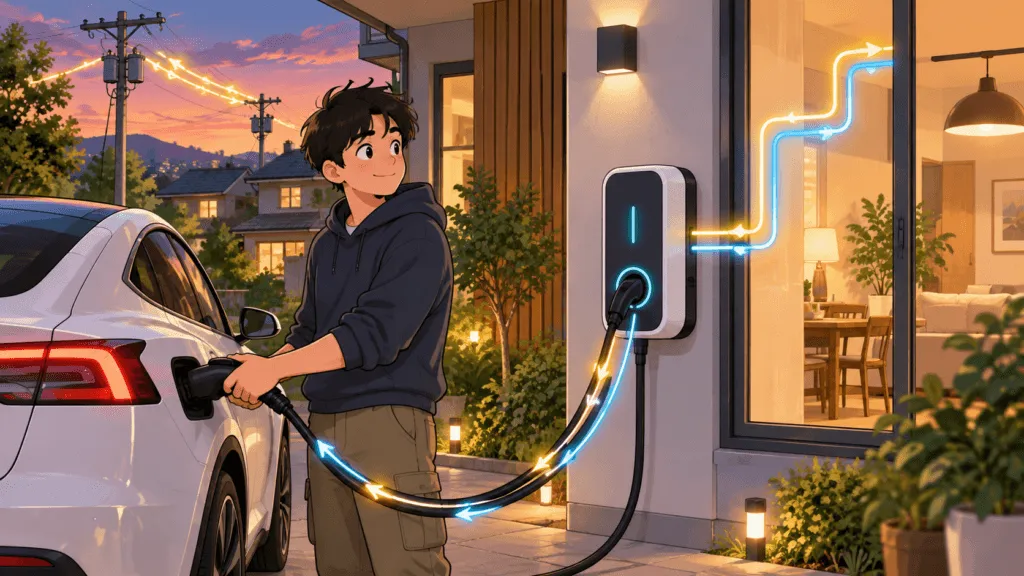
Owning an electric vehicle is easiest when you can plug it in at home every night.
But a garage is not required.
If you live in an apartment, park on the street, or simply do not have a private driveway, you can still own and charge an EV. The difference is that charging becomes something you need to plan rather than something that happens automatically while you sleep.
In practice, the best solution usually comes from combining apartment or workplace charging with public Level 2 or DC fast charging.
The right setup depends on where the car spends most of its time.
You Do Not Actually Need a Garage for Home Charging
First, it is worth separating two different situations.
If you do not have a garage but do have a private outdoor parking space, home charging may still be possible.
The U.S. Department of Energy says EV charging equipment can be installed outdoors and used safely in the rain when the equipment is rated for outdoor use. A Level 1 outlet or Level 2 charging station can therefore be installed outside near a parking space.
That means a carport, side parking pad or outdoor assigned space may work just as well as a garage.
The electrical installation still needs to be suitable for continuous EV charging, and the charger location should avoid vehicle impact and tripping hazards. Local electrical, building and permitting requirements may also apply.
👉 If you are considering installing a charger at home, read Do You Need an Electrical Panel Upgrade? before assuming your existing electrical service can handle the additional load.
Apartment Charging Is Often the Best Long-Term Solution
For apartment and condominium residents, the first place to investigate is the building itself.
Multifamily EV charging can be more complicated than charging at a single-family home because parking ownership, electrical service, billing and installation responsibility may involve several different parties.
DOE specifically notes that multifamily housing requires additional planning around parking access, electrical service, payment and legal considerations.
If your apartment already has chargers, the problem is easy.
If it does not, ask the property manager or homeowners association whether EV charging is planned or whether a charger can be installed at your assigned space.
The cost can vary widely depending on how far the parking area is from the electrical room and whether the building has enough available electrical capacity.
For renters, it usually makes more sense to involve the property owner than to attempt any permanent installation independently.
Workplace Charging Can Replace Home Charging for Many Drivers
If your car sits at work for eight hours a day, that parking time can become your charging window.
Workplace Level 2 charging is particularly useful because a vehicle does not need to charge quickly when it is already parked for most of the workday.
DOE says Level 2 is the most commonly used type of workplace charging, while some workplaces also provide Level 1 outlets for employees with lower daily driving needs.
This can work especially well for commuters.
Instead of arriving home and looking for a charger, you arrive at work, plug in, and recover much of the energy used during your commute before leaving.
Before buying an EV without home charging, checking whether your employer already offers charging — or plans to — is worth doing.
Public Level 2 Charging Works Best When You Are Already Parked
Public Level 2 charging is another practical option, especially when chargers are located somewhere you normally spend time.
DOE estimates Level 2 charging typically adds roughly 10 to 30 miles of range per hour, although the actual rate depends on the vehicle and charger.
That makes Level 2 useful at places such as shopping centers, municipal parking garages, workplaces, hotels and other locations where a car may remain parked for several hours.
The key is convenience.
Driving 20 minutes specifically to use a slow charger may become frustrating.
Charging while you are already at the gym, grocery store, office or parking garage is much easier to sustain.
DC Fast Charging Can Work, but It Should Fit Your Routine
For drivers without any reliable Level 2 charging, DC fast charging can become the main alternative.
DOE says modern DC fast chargers can add roughly 100 to 200 or more miles of range in about 30 minutes, depending on the vehicle, charger power and battery conditions.
That makes EV ownership possible even without a home charger.
However, public DC fast charging is generally more expensive than residential electricity. DOE notes that drivers can normally expect to pay more at public stations, particularly DC fast chargers, than they would charging at home.
So before buying an EV, look at the fast chargers near your home, workplace and normal travel routes.
A nearby reliable charger matters more than having dozens of chargers that require a long detour.
Curbside Charging Is Becoming a Real Option
Street parking has historically been one of the hardest situations for EV owners.
That is starting to change in some cities.
New York City is a useful example.
NYC already operates curbside Level 2 chargers and announced in August 2026 that it plans to add 600 additional curbside charging points over the next three years, expanding a network that currently includes 88 Level 2 ports.
The city says many residents rely on street parking, which makes private home charging impractical.
Its existing curbside chargers have also shown high utilization, providing evidence that on-street charging can work in dense urban neighborhoods.
Other cities are exploring similar approaches, so checking your local transportation department or utility is worthwhile if you depend on street parking.
Be Careful With Extension Cords and Sidewalk Charging
One tempting idea is to run a cord from the house to a car parked on the street.
That is not something I would treat as a normal charging solution.
EV charging is a continuous electrical load, and outdoor equipment, receptacles and circuits need to be appropriate for that use. DOE recommends dedicated circuits for Level 1 home charging and emphasizes proper equipment and installation.
A cable crossing a public sidewalk also creates a trip hazard and may conflict with local rules.
If your vehicle parks on public property, check with your city or utility before trying to run power from a private building to the curb.
Which Option Works Best Without Home Parking?
A simple way to think about it is:
| Your situation | Most practical charging option |
|---|---|
| Apartment with assigned parking | Building Level 2 charger |
| Outdoor private parking | Outdoor-rated home Level 1 or Level 2 |
| EV chargers at work | Workplace Level 2 |
| Street parking in a city | Curbside/public Level 2 |
| No reliable overnight charger | Nearby DC fast charging |
| Mixed driving routine | Workplace + public Level 2 + occasional DC fast charging |
For many drivers, the best answer is not one charger.
It is a charging routine.
Check Charging Before You Buy the EV
If you cannot charge at home, charging infrastructure should be part of the vehicle-buying decision.
Use the DOE Alternative Fueling Station Locator to look at chargers near your home, workplace and regular routes.
Also check which connector your vehicle uses and whether the chargers you expect to rely on are Level 2 or DC fast chargers.
Public charging networks vary in price, availability and payment method, so checking the stations you would actually use is more useful than looking only at a nationwide charger count.
My View From the Electrical Construction Side
From an electrical perspective, not having a garage is not the real limitation.
The real issue is having a safe, legal and reliable connection between the electrical system and the place where the vehicle parks.
If the parking space is private, an outdoor charger may solve the problem.
If parking belongs to an apartment complex, the challenge shifts to electrical capacity, wiring distance, metering and ownership.
If the car is parked on a public street, charging becomes a public-infrastructure problem rather than a household electrical project.
That distinction is useful when deciding whether an EV fits your situation.
Final Thoughts
You can own an EV without a garage or driveway, but it is worth planning the charging routine before buying the car.
Apartment charging and workplace charging are usually the most convenient alternatives to a private home charger.
Public Level 2 charging works well when it overlaps with places you already spend time, while DC fast charging can fill the gaps or serve as the main option for drivers with no overnight charging access.
Curbside charging is also expanding in cities where street parking is common.
The important question is not whether you have a garage. It is whether you have dependable charging available where your car already spends time.
Sources & Official References
This article was researched using U.S. Department of Energy, Alternative Fuels Data Center and New York City Department of Transportation materials on home, multifamily, workplace, public and curbside EV charging.
U.S. Department of Energy Alternative Fuels Data Center — Electric Vehicles for Consumers
Open official source
Alternative Fuels Data Center — Charging Electric Vehicles at Home
Open official source
Alternative Fuels Data Center — Electric Vehicle Charging for Multifamily Housing
Open official source
Alternative Fuels Data Center — Workplace Charging for Electric Vehicles
Open official source
Alternative Fuels Data Center — Charging Electric Vehicles in Public
Open official source
New York City DOT — 2026 Curbside EV Charging Expansion
Open official source
Sources checked September 18, 2026.
Is there something you’d like to see?
Suggest an electrical topic, practical guide, or calculator you would like to see on JHOTAS-LAB. Your suggestion may help shape future content.