
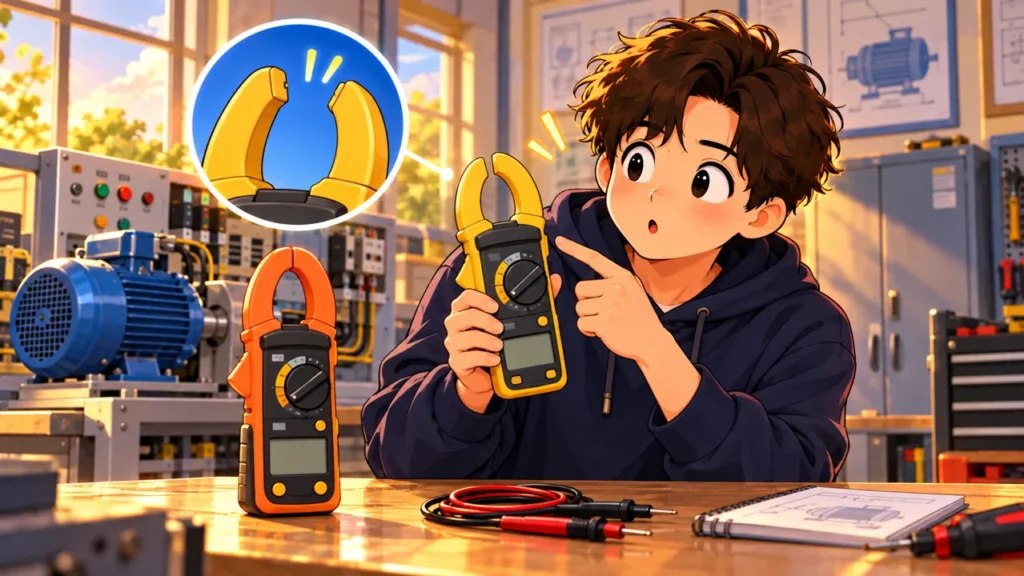
Fluke 325 vs Klein CL810: choose the Fluke 325 if you want a compact 400A AC/DC True-RMS clamp meter for routine commercial troubleshooting. Consider the Klein CL810 if you need a wider 600A clamp range, additional diagnostic functions, an illuminated work area, and higher published voltage/CAT ratings. These are different priorities—not a claim that the more feature-rich meter is automatically better or safer for every job.
A clamp meter is a purchase you should match to the measurement point, not just the price. If your work includes feeders, motor circuits, building maintenance, or HVAC controls, the questions below can keep you from buying features that do not help or overlooking a required rating.
Affiliate disclosure: This guide may contain eBay Partner links. A qualifying purchase may earn a commission at no additional cost to you. Product listings, conditions, shipping, and prices change.
Fluke 325 vs Klein CL810: Specification Comparison
| Specification | Fluke 325 | Klein CL810 |
|---|---|---|
| Jaw AC/DC current range | Up to 400A AC/DC | Up to 600A AC/DC |
| Voltage via leads | Up to 600V AC/DC | Up to 1000V AC/DC |
| Published safety category | CAT III 600V; CAT IV 300V | CAT III 1000V; CAT IV 600V |
| True-RMS AC measurements | Yes | Yes |
| Temperature probe | Yes | Yes |
| Low-impedance voltage (LoZ) | Not listed as a primary 325 feature | Yes |
| Inrush current / DC µA | Not specified among main 325 capabilities | Listed |
| Worklight and non-contact indication | Not listed as integrated features | Integrated worklight and NCV |
| Jaw opening | 30 mm conductor diameter | 1.4-inch jaw size |
These values are from the manufacturers’ published product specifications, not performance testing by JHOTAS-LAB. A larger current range does not automatically mean better resolution or accuracy at every current level. Read the stated accuracy, the relevant ranges, and the user’s manual for your application.
Where the Fluke 325 Makes Sense
Fluke specifies 40A and 400A ranges for both AC and DC clamp current. It also provides True-RMS AC readings, frequency, capacitance, and contact temperature with a K-type thermocouple. For an electrician who usually checks branch loads, building distribution, or general equipment operation within the instrument’s rating, that is a useful set of functions without a complicated interface.
Its published CAT III 600V / CAT IV 300V rating makes the installation category an essential buying check. For example, do not assume a 600V reading range is approval to use the clamp at every 600V service entrance point. The installation category and rated voltage must match the measurement environment.
Before paying for a used Fluke 325, check the model label, jaws, included test leads and thermocouple, case condition, and evidence of impact or improper repairs. Ask whether the seller provides a genuine instrument, functional checks, a calibration certificate if needed, and a return option.
Where the Klein CL810 Adds Value
Klein’s CL810 is specified for up to 600A AC/DC current and up to 1000V AC/DC voltage, with CAT III 1000V / CAT IV 600V category ratings. The manufacturer also lists inrush, DC microamps, low-impedance voltage mode, a reverse-contrast display, an integrated worklight, and non-contact voltage indication. That combination may matter to someone who handles a wider variety of maintenance calls.
The built-in light and lead holder can make inspection or setup more convenient in a dim cabinet. Neither is a substitute for task lighting or safe positioning. Non-contact voltage detection is an aid, not a proof of de-energization; verify absence of voltage with the appropriate method before working.
If you are comparing a CL810 listing with an older Klein CL800, check the model number carefully. Klein identifies the CL800 as a discontinued product and the CL810 as a newer model. A bargain listing for a CL800 should not be mistaken for the current CL810 specification.
A Simple Field-Work Buying Decision
- Mostly 0–400A building maintenance: the Fluke 325 may cover your requirements without paying for extra functions.
- Need to measure DC current up to 600A: compare the CL810’s specified range, accuracy, and jaw access to the task.
- Regularly diagnose inrush or ghost-voltage symptoms: the CL810 lists specialized features that may matter.
- Higher-category measurement point: select the instrument, leads, and protection method whose full ratings suit the job.
- Work with VFD outputs: neither model should be assumed suitable for every PWM waveform measurement without consulting the manufacturer’s guidance.
Also consider whether you need a clamp meter at all. A multimeter is often a better fit for resistance, low-level voltage, and other checks requiring higher functional resolution. Our Fluke 117 vs 87V comparison explains how job type changes the right purchase; the breaker trips when an AC unit starts guide illustrates why inrush and steady-state load are different questions.
If you are only trying to identify which circuit breaker supplies an outlet, a clamp meter’s current reading is not a substitute for a safe identification method. See how to find which breaker controls an outlet before purchasing a tool for the wrong task.
Check Live eBay Listings for Both Models
The cards below request current eBay listings automatically. They are marketplace listings, not a certified catalog or guaranteed pricing. Check whether the listing matches the exact 325 or CL810 model, and verify that any included leads, thermocouple, accessories, seller terms, and condition match the manufacturer’s configuration.
Fluke 325 True-RMS AC/DC Clamp Meter
Compare Fluke 325 listings →As an eBay Partner, I may be compensated if you make a purchase.
Klein Tools CL810 AC/DC Clamp Meter
Compare Klein CL810 listings →As an eBay Partner, I may be compensated if you make a purchase.
Looking beyond clamp meters? Explore JHOTAS Jobsite Tool Deals for drilling, conduit, welding, field testing, and other contractor tools. Review each listing’s condition and total cost before purchasing.
What to Check When Buying a Used Clamp Meter
- Look for damage to the jaw faces, hinge, rotary switch, case, display, and input terminals.
- Check any meter serial or model identifiers and be cautious with unusually cheap or confusing listings.
- Confirm that leads have appropriate CAT/voltage ratings and have intact insulation.
- Ask about the meter’s functional condition and calibration where traceable measurements matter.
- Check return policy, shipping origin, and whether warranty benefits apply to second-hand buyers.
- Treat missing lead caps, unauthorized repairs, and moisture damage as reasons to investigate further.
Frequently Asked Questions
Does Fluke 325 measure DC current through the jaw?
Yes. Fluke lists a 400A DC clamp-current range. Verify the range, zeroing, and accuracy requirements in the official manual before measuring a DC system.
Is Klein CL810 necessarily better because it reaches 600A?
No. The larger range is helpful only if your measurements require it. At lower currents you still need to compare specified accuracy, ergonomics, jaw access, and complete safety ratings.
Can either clamp meter replace a voltage tester or safe work procedure?
No. Do not rely on non-contact detection or an instrument’s headline rating as proof that a circuit is de-energized. Follow appropriate lockout, test-before-touch, and verified-proving procedures.
Bottom Line
Fluke 325: a strong candidate for general 400A AC/DC clamp-meter work. Klein CL810: worth examining when the larger range, worklight, LoZ, inrush, and additional functions serve real tasks. Compare complete instruments—not only marketplace price—and use the manufacturer’s current instructions for your measurement environment.
Electrical safety: CAT rating, voltage limit, accessories, inspection, and safe work procedures matter more than a product comparison. Never assume a meter makes live work safe; follow the manufacturer instructions and use appropriately trained personnel.
About the author: I work in electrical construction and electrical project coordination in South Korea. This buying guide compares published manufacturer specifications and practical job requirements; it is not a claim that I personally field-tested every product.
Sources & Official References
- Fluke — 325 True-RMS Clamp Meter: official product and specifications
- Klein Tools — CL810 600A AC/DC Clamp Meter: official specifications
- Klein Tools — CL800 model status and successor
Is there something you’d like to see?
Suggest an electrical topic, practical guide, or calculator you would like to see on JHOTAS-LAB. Your suggestion may help shape future content.

