
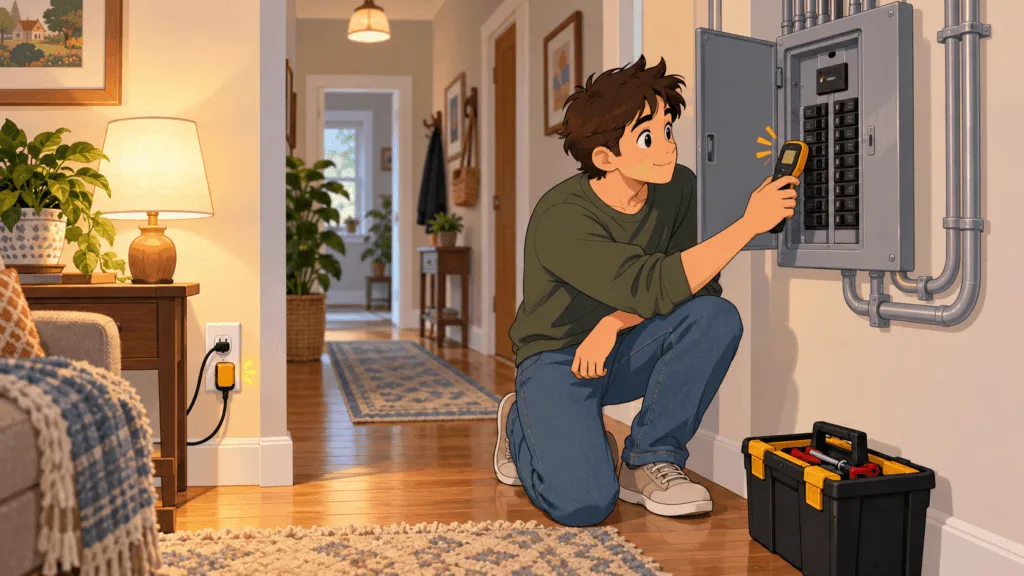
You need to replace an outlet, troubleshoot a dead receptacle, or simply label your electrical panel.
But there is one problem:
You have no idea which breaker controls the outlet.
The safest approach is to identify the circuit before doing any electrical work.
For most homeowners, there are three practical methods:
- Use a lamp or plug-in device and a helper.
- Turn breakers off one at a time.
- Use a circuit breaker finder.
If you expect to identify more than one circuit, a breaker finder can save a surprising amount of time.
Method 1: Use a Lamp and a Helper
The simplest method requires no special electrical tool.
Plug a lamp into the outlet you want to identify and turn the lamp on.
Then have one person stay near the lamp while another person goes to the electrical panel.
Switch one branch-circuit breaker off at a time until the lamp turns off.
Once the lamp goes dark, you have probably found the breaker supplying that outlet.
Turn the breaker back on and verify that the lamp comes on again.
This second check is important because it confirms that you identified the correct circuit rather than having the lamp fail or become unplugged at the same time.
ESFI recommends identifying and labeling electrical panel circuits so homeowners can quickly disconnect the correct area during maintenance or an emergency.
Method 2: Find the Breaker by Yourself
If you are working alone, the same basic method still works, but it can involve a lot of walking.
Plug in a lamp, radio, or another device that makes it easy to tell when power disappears.
Go to the panel.
Turn one breaker off.
Return to the outlet.
Check whether the device is still operating.
If it is, turn that breaker back on and try another.
For a small panel this may only take a few minutes.
For a large house with dozens of breakers, however, it becomes tedious very quickly.
Before intentionally switching circuits off, consider equipment that should not unexpectedly lose power, such as computers or other sensitive devices.
And you should never remove the panel cover or touch internal conductors just to identify a circuit.
You only need access to the normal breaker handles on the front of the panel.
Method 3: Use a Circuit Breaker Finder
This is the method I would choose if I had several outlets or circuits to identify.
A circuit breaker finder normally has two parts:
a transmitter and a receiver.
The transmitter plugs into the outlet.
The receiver is then moved across the front of the breakers until it identifies the breaker associated with that transmitter.
One example is the Klein Tools ET310 Digital Circuit Breaker Finder with GFCI Outlet Tester.
According to Klein Tools, the ET310 operates on 90–120V AC circuits and provides audible and visual indications when the receiver identifies the correct breaker. Its transmitter can also check common outlet wiring conditions and test GFCI devices.
A Tool That Makes This Job Much Easier
Klein Tools ET310 Circuit Breaker Finder
If your panel is poorly labeled or you expect to trace several outlets, this is the type of tool that can make the job much faster.
Instead of repeatedly walking between the outlet and panel, you plug the transmitter into the receptacle and scan the breakers with the receiver.
👉 [Check Current Price – Klein Tools ET310]
Affiliate disclosure: I may earn a commission if you purchase through this link, at no additional cost to you.
To browse contractor test equipment and circuit-tracing tools when available, see JHOTAS Jobsite Tool Deals & Price Watch. Verify exact compatibility, ratings and included accessories; available listings may change.
How to Use a Breaker Finder
The general process is straightforward.
Plug the transmitter into a known working grounded outlet.
Turn on the receiver and follow the manufacturer’s calibration or scanning procedure.
Move the receiver slowly across the face of each breaker.
Once the device indicates the strongest or confirmed signal, note that breaker.
Then switch that breaker OFF and verify that the outlet actually lost power.
Always verify the result.
A tester is a useful tool, but I would never rely on a single indication before working on an electrical circuit.
Klein also advises users to verify tester operation on a known live and correctly wired receptacle before use and warns against using the unit on electrical systems above its 120V rating.
Label the Breaker Once You Find It
Do not solve the same problem twice.
Once you know which breaker controls the outlet, update the panel directory.
Instead of vague labels such as:
Bedroom
use something more specific if possible:
Master Bedroom Outlets
or
Living Room North Wall Outlets
A clear circuit directory makes future troubleshooting much easier.
It also helps when you need to disconnect power quickly.
One Breaker May Control More Than One Room
Do not assume that one breaker always equals one room.
Residential branch circuits can serve several receptacles or even portions of multiple rooms depending on how the home was wired.
Once you identify the breaker, test nearby outlets too.
You may discover that the same circuit supplies:
- Several bedroom outlets
- Hallway receptacles
- Lighting
- Adjacent rooms
This is one reason accurate breaker labeling is so useful.
My View From the Electrical Side
From my perspective working around electrical systems, poorly labeled panels create unnecessary work.
Finding one breaker manually is not difficult.
Finding ten of them is another story.
If I only needed to identify one outlet once, I would probably use a lamp and turn the breakers off one at a time.
But if I had just moved into a house with a poorly labeled panel, a circuit breaker finder would make much more sense.
You can identify multiple circuits and build a proper panel directory at the same time.
That is also why I think a breaker finder is one of those tools homeowners may not use every week, but when they need it, it solves a very specific problem quickly.
What If the Outlet Still Has Power?
If you switch off the breaker you believe controls the outlet and the receptacle still appears energized, stop and verify your test method.
You may have identified the wrong breaker.
If the wiring behaves unexpectedly or you find damaged outlets, overheating, frequent breaker trips, buzzing, or other abnormal conditions, contact a qualified electrician.
Breakers are safety devices designed to protect branch-circuit wiring from unsafe current conditions, not simply switches for experimentation.
If the outlet behaves unexpectedly, see why an outlet may stop working without a tripped breaker. Before attempting repairs, review common DIY electrical safety mistakes. These guides do not replace qualified electrical diagnosis.
Final Thoughts
If you need to find which breaker controls an outlet, start simple.
For one outlet, use a lamp and a helper.
For a few circuits, switch breakers one at a time.
But if your panel is poorly labeled or you want to map several circuits, a circuit breaker finder is probably the easiest solution.
Whichever method you use, always verify that the outlet has actually lost power before beginning electrical work.
And once you find the correct breaker:
label it.
You will probably thank yourself the next time you need it.
Is there something you’d like to see?
Suggest an electrical topic, practical guide, or calculator you would like to see on JHOTAS-LAB. Your suggestion may help shape future content.

