
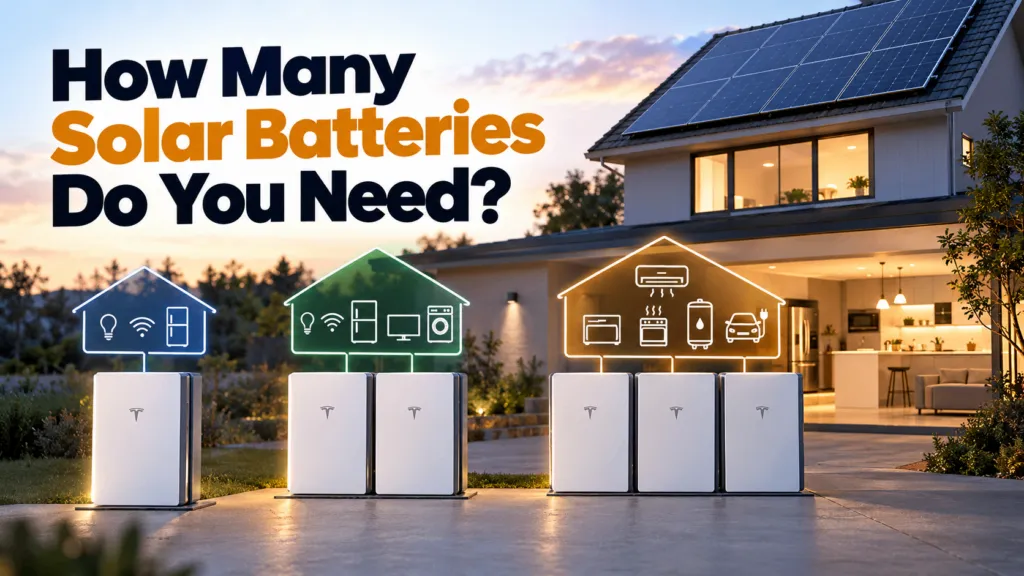
For many homes, one battery can cover essential circuits.
Whole-home backup is different.
If you want air conditioning, kitchen appliances, pumps, lighting, electronics and other circuits to continue operating normally during an outage, two or more batteries may be required.
But the correct number cannot be determined by house size alone.
You need to calculate both energy capacity in kWh and power output in kW.
Before comparing battery counts, use the free Blackout Survival Calculator to estimate the nominal energy needed for your chosen loads and backup duration. Confirm inverter output and motor startup separately.
Start With What You Actually Want to Back Up
There are two very different versions of home backup.
Battery count starts with runtime. Read How Long Can a Solar Battery Power a House During an Outage? to estimate how quickly your backup loads will use stored energy.
Essential-load backup
This may include:
- refrigerator,
- lights,
- internet,
- phone charging,
- selected outlets,
- medical equipment,
- and possibly a gas furnace blower.
The average load can remain relatively low.
Whole-home backup
Now add:
- central air conditioning,
- electric water heating,
- electric cooking,
- well pumps,
- laundry equipment,
- and potentially EV charging.
The battery requirement can increase dramatically.
That is why “one battery per house” is not a useful sizing rule.
A Simple Way to Estimate Battery Capacity
Start with the average power you expect to use during the outage.
Then multiply it by the number of hours you want the system to operate.
Average load × backup hours = required energy
Suppose your critical loads average 0.6 kW and you want 12 hours of backup.
0.6 kW × 12 hours = 7.2 kWh
From an energy standpoint, one 13.5 kWh-class battery provides substantial room for that simplified load.
Now suppose your home averages 1.5 kW during backup.
1.5 × 12 = 18 kWh
One 13.5 kWh battery is no longer enough for the full 12-hour target before considering losses and reserve capacity.
Two batteries become much more reasonable.
At an average 3 kW for 12 hours:
3 × 12 = 36 kWh
Now you are in the range of roughly three 13.5 kWh-class batteries from an energy-capacity perspective.
These are planning examples, not system designs, but they show why the number of batteries increases quickly when whole-home loads are included.
Battery Count by Backup Goal
A useful way to think about it is:
| Backup goal | Typical direction |
|---|---|
| Refrigerator + Wi-Fi + lights | Often one battery |
| Essentials + several household circuits | One or two |
| AC + normal household usage | Often two or more |
| High-use all-electric home | Multiple batteries likely |
| Multi-day autonomy without solar | Much larger storage requirement |
The exact answer depends on your appliances, climate and battery model.
Do Not Size the System Using kWh Alone
This is one of the biggest mistakes in battery sizing.
Imagine you have plenty of stored energy but the battery can only deliver 5 kW continuously.
If the house suddenly asks for 8 kW, the energy capacity does not solve the problem.
You also need enough power output.
Tesla’s Powerwall 3, for example, stores 13.5 kWh and supports high AC output, while Enphase’s IQ Battery 5P uses smaller 5 kWh modules with 3.84 kW of continuous output each.
Different products therefore reach the same total storage capacity in very different ways.
One large battery and three smaller batteries may have similar stored energy but different output, installation architecture and expansion options.
Large Motors Can Determine the System Size
Central AC compressors, well pumps and other motors can require a short burst of power when starting.
That surge can be much larger than normal running power.
A house might therefore use only 2 kW on average but still require a much higher instantaneous output when an air conditioner starts.
This is why installers look at:
continuous load + startup load + stored energy
rather than only the monthly electric bill.
Solar Can Reduce the Number of Batteries You Need
If the battery is paired with properly configured solar, the system may recharge during the daytime.
That changes the calculation.
Without solar, a 24-hour outage requires enough stored energy to cover the entire period.
With solar, the design may instead aim to store enough electricity to get through the night and periods when solar production is low.
But solar availability is not guaranteed.
Cloud cover, snow, shading and seasonal production can reduce the energy available for charging.
A resilient system should not be sized around a perfect sunny day.
👉 👉 Solar can recharge a battery during an outage only when the system is designed for backup operation. Read Do Solar Panels Work During a Power Outage? to understand why standard grid-tied solar normally shuts down
Do You Really Need Whole-Home Backup?
Not necessarily.
Backing up every circuit sounds attractive, but it can make the project considerably more expensive.
Think about an electric dryer.
During a normal afternoon, using several kilowatt-hours may not matter.
During a prolonged outage, that same energy might be more valuable for refrigeration, lighting and communications.
Load-management systems can allow many circuits to remain connected while automatically preventing excessive loads from operating simultaneously.
That can sometimes provide a whole-home experience without sizing the battery system for the theoretical maximum load of every appliance operating at once.
One Battery vs. Two vs. Three
A simple way to frame the decision:
One battery:
Good starting point for critical loads and shorter outages.
Two batteries:
More energy, more power and better ability to support larger household loads.
Three or more:
Moves toward whole-home and longer-duration backup, especially for all-electric homes.
But adding batteries indefinitely is not always the most economical solution.
If outages regularly last several days, a generator or hybrid solar-battery-generator system may provide another way to handle rare long-duration events.
👉 If adding more batteries starts becoming expensive, compare the alternative in Solar Battery vs Generator: Which Is Better for Home Backup?.
My View From the Electrical Construction Side
I would size backup from the circuits backward.
First decide what must stay on.
Then identify the continuous load and large motor starting requirements.
After that, calculate how many hours of stored energy are required.
Only then does it make sense to choose the battery quantity.
A system designed this way is usually more useful than simply buying two batteries because a neighbor has two batteries.
Electrical loads are what determine the design.
Final Thoughts
There is no fixed number of solar batteries required for every house.
One battery may be enough for essential loads.
Two may support a wider portion of the home.
Whole-home backup with air conditioning and other large electrical loads can require three or more, depending on battery capacity and household demand.
The important calculation is:
How much power do I need at once?
and
How many kWh do I need before the battery can recharge?
Answer those two questions first, and the battery count becomes much easier to determine.
Sources & Official References
Tesla — Powerwall 3 Specifications
Tesla Powerwall 3 specifications
Enphase — IQ Battery 5P
Enphase IQ Battery 5P specifications
U.S. Department of Energy — Solar Energy Guide for Homebuilders
DOE solar and battery backup guidance
Is there something you’d like to see?
Suggest an electrical topic, practical guide, or calculator you would like to see on JHOTAS-LAB. Your suggestion may help shape future content.