
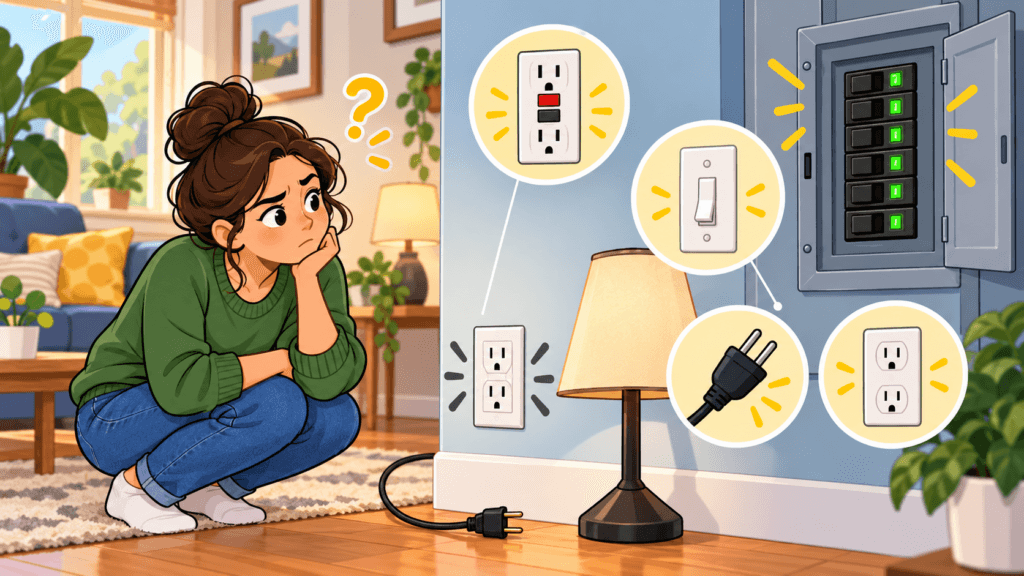
You plug something into an outlet and nothing happens.
You check the electrical panel, but every breaker appears to be ON.
So why is the outlet dead?
The most common causes are surprisingly simple: a tripped GFCI somewhere else on the circuit, a breaker that does not visibly look tripped, a wall-switch-controlled outlet, or a failed outlet.
However, a loose or damaged electrical connection can also cause the same symptom.
Before removing an outlet or touching any wiring, check the simple and safe possibilities first.
1. Check for a Tripped GFCI Outlet
This is one of the first things I would check.
A GFCI outlet can protect other outlets connected downstream from it.
That means the dead outlet may not even have TEST and RESET buttons.
For example, an outlet in a bathroom, garage, basement, kitchen, laundry area, or outdoors may be protected by another GFCI located somewhere else.
According to the Electrical Safety Foundation International, GFCI protection is commonly required in areas such as bathrooms, garages, kitchens, basements, laundry areas, outdoor locations, and receptacles near sinks.
Look around the house for an outlet with TEST and RESET buttons.
Press RESET firmly.
Then check the dead outlet again.
If the GFCI will not reset, do not repeatedly force it. A fault may still exist, or the GFCI itself may need replacement. ESFI recommends replacement or professional inspection when the test/reset function does not work correctly.
2. Reset the Breaker Even If It Looks ON
A tripped breaker is not always obvious.
Some breakers move clearly to OFF when they trip, while others may stop somewhere between ON and OFF.
Instead of only looking at the breaker, identify the circuit and reset it properly.
First unplug appliances connected to the affected circuit.
Then move the breaker completely to OFF and back to ON.
ESFI gives the same basic procedure for resetting a tripped residential breaker. If the problem immediately returns, an electrician should investigate the circuit.
If the breaker trips again, do not keep resetting it.
The breaker may be responding to an overload, short circuit, ground fault, or another electrical problem.
3. Test Other Outlets in the Same Room
Next, find out whether you have:
one dead outlet
or
several dead outlets.
Plug a small working device, such as a lamp, into nearby outlets.
If only one outlet has lost power, the problem may be located at that receptacle or one of its connections.
If several outlets are dead, they may share the same branch circuit, GFCI protection, or upstream connection.
This simple test can tell you a lot before any electrical work begins.
4. Check the Wall Switch
This sounds almost too simple, but it happens frequently.
Some homes have receptacles controlled by a wall switch.
Sometimes the entire outlet is switched.
Sometimes only one half of a duplex receptacle is controlled by the switch while the other half remains continuously powered.
If an outlet suddenly appears dead, especially in a bedroom or living room, try the nearby wall switches.
Someone may simply have turned off the switched receptacle.
5. Make Sure the Appliance Is Actually Working
Before blaming the outlet, test the device somewhere else.
A failed charger, lamp, power strip, or appliance can easily make a perfectly good outlet appear dead.
Plug the device into a known working receptacle.
Then plug another known working device into the suspected outlet.
That quickly separates an outlet problem from an appliance problem.
6. The Outlet Itself May Have Failed
Receptacles do not last forever.
Internal contacts can wear, connections can loosen, and heat damage can develop over time.
Warning signs include:
- Brown or black discoloration
- A burnt smell
- Crackling or buzzing
- A plug that feels unusually loose
- An outlet that feels hot
- Visible melting or damage
If you notice any of these symptoms, stop using the outlet.
Electrical safety organizations also recommend replacing damaged outlets and having questionable electrical systems inspected by qualified professionals.
A dead receptacle with heat or burn marks is not something I would treat as a simple inconvenience.
7. There May Be a Loose Connection Upstream
This is where troubleshooting becomes more complicated.
Electric outlets on a branch circuit are often connected through multiple boxes.
A failed or loose connection at one point can sometimes cause another outlet farther down the circuit to lose power.
The problem may therefore be located at:
- The dead receptacle
- Another receptacle
- A junction box
- A switch
- The electrical panel
- Another connection upstream
At this stage, troubleshooting normally requires electrical testing.
This is where I recommend stopping the DIY checks and calling a qualified electrician.
Opening receptacles and testing energized conductors introduces shock and fire hazards, especially if you do not know how the circuit is wired.
My View From the Electrical Field
When an outlet stops working but the breaker looks normal, I would not immediately assume the breaker is bad.
I would check the circuit in this order:
GFCI → breaker reset → nearby outlets → wall switch → appliance → professional electrical inspection.
The important thing is to separate the simple causes from actual wiring problems.
From my experience around electrical work, one dead outlet can sometimes be more complicated than it looks.
An electrical circuit is a connected system.
The outlet where you notice the problem is not necessarily where the problem started.
That is why randomly replacing the dead receptacle does not always solve the issue.
When Should You Call an Electrician?
Call an electrician if:
- The breaker trips again after resetting
- The GFCI will not reset
- Multiple outlets suddenly lose power
- The outlet is hot
- You smell burning
- You hear buzzing or crackling
- There is visible discoloration or melting
- The simple checks above do not restore power
AFCIs and GFCIs are designed to disconnect electricity when certain hazardous conditions are detected, so repeatedly bypassing or resetting protective devices without finding the cause is not a good troubleshooting method.
Final Thoughts
If an outlet is not working but the breaker isn’t tripped, start with the easiest possibilities.
Check for a tripped GFCI elsewhere in the house.
Reset the breaker fully OFF and ON.
Test nearby outlets.
Check the wall switches.
And confirm that the appliance itself works.
In many cases, one of those steps identifies the problem.
But if the outlet remains dead — especially if you notice heat, burning smells, discoloration, repeated breaker trips, or multiple dead outlets — stop troubleshooting and have the circuit inspected.
The key is not simply getting the outlet working again.
It is finding out why it lost power in the first place.
Is there something you’d like to see?
Suggest an electrical topic, practical guide, or calculator you would like to see on JHOTAS-LAB. Your suggestion may help shape future content.
