
If you are budgeting for commercial solar in 2026, one number usually comes up first:
How much does commercial solar cost per watt?
A useful U.S. market benchmark is currently around $1.72 per watt DC for commercial solar systems, based on Q4 2025 pricing reported by SEIA and Wood Mackenzie.
But that number should be treated as a benchmark — not a guaranteed quote.
A real commercial solar project can cost significantly more or less depending on system size, roof conditions, electrical equipment, labor, permitting and grid interconnection.
That is why comparing commercial solar only by panel price can be misleading.
What Does Commercial Solar Cost Per Watt in 2026?
SEIA’s latest published market data puts average U.S. commercial solar system pricing at approximately $1.72/Wdc in Q4 2025. That was about 10% higher than a year earlier.
Interestingly, the increase did not come simply from more expensive solar panels.
SEIA reported that raw materials including steel, copper and aluminum became significantly more expensive, while electrical and structural equipment costs also increased.
This is important for commercial projects.
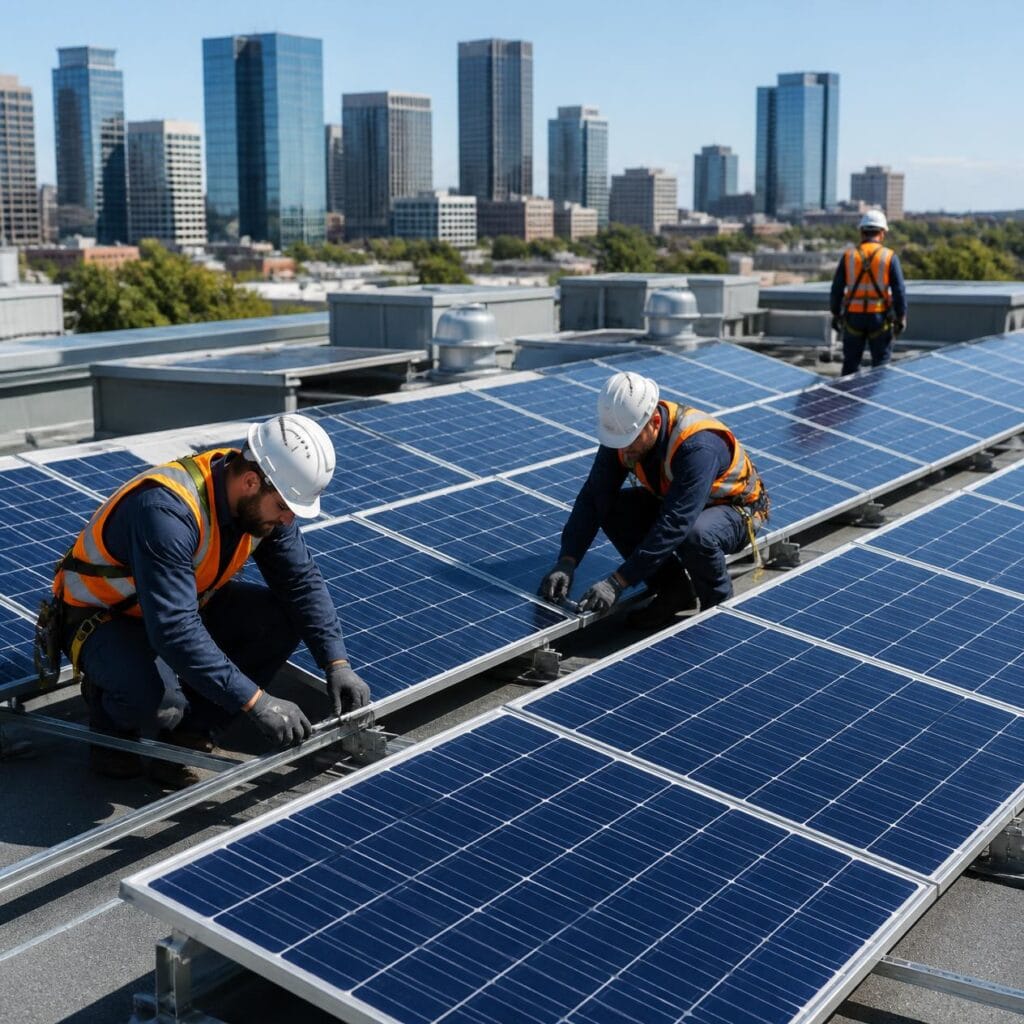
A solar installation is much more than modules on a roof.
You may also need:
- Inverters
- Racking
- Electrical panels
- Switchgear
- Transformers
- Conductors and conduit
- Protection equipment
- Engineering
- Permits
- Labor
- Utility interconnection work
Those costs can have a major impact on the final installed price.
Commercial Solar Cost by System Size
Using approximately $1.72/W as a simple market benchmark gives us a useful starting point.
| System Size | Cost at $1.72/W |
|---|---|
| 50 kW | About $86,000 |
| 100 kW | About $172,000 |
| 250 kW | About $430,000 |
| 500 kW | About $860,000 |
| 1 MW | About $1.72 million |
These are rough planning examples before incentives, not project quotes.
Actual pricing can vary significantly.
Larger installations also often achieve lower costs per watt because engineering, mobilization and other fixed costs are spread across more generating capacity.
NREL has similarly noted that economies of scale are clearly visible in commercial rooftop solar, with per-watt construction costs generally declining as system size increases.
Why Can Two 100 kW Systems Have Very Different Prices?
This is where commercial solar gets interesting.
Two buildings could both install 100 kW systems but receive very different quotes.
Why?
Roof Type
A large, simple flat roof can be easier to work with than a complicated roof with multiple levels, obstacles or structural limitations.
Structural reinforcement can also increase project cost.
Electrical Infrastructure
This is one of the areas I pay particular attention to.
The existing electrical system may not always be ready for the proposed solar capacity.
A project could require upgrades to switchgear, distribution panels, transformers or other equipment before the solar installation can be connected safely.
Utility Interconnection
Installing the panels does not automatically mean you can connect them to the grid.
The utility may require studies, protection changes, metering equipment or additional infrastructure.
For some projects, interconnection can become an important part of both cost and schedule.
Labor and Location
Commercial electrical labor costs vary significantly by region.
Permitting requirements, local regulations and site accessibility can also affect installation cost.
This is why a national cost-per-watt average should always be treated as a planning tool rather than a final budget.
My View From the Electrical Construction Side
From my perspective working around electrical construction, I think people often pay too much attention to solar panel prices.
Panels are easy to see, so naturally people assume they represent most of the project.
But from an electrical point of view, what happens behind those panels can be just as important.
For a larger commercial system, you have to think about how hundreds of kilowatts of generation actually connect into the building.
Can the existing distribution equipment handle it?
Does the transformer have enough capacity?
Does the switchgear need modification?
How will protection work?
How long will the utility interconnection process take?
These questions can change a project budget dramatically.
That is why I would never evaluate two commercial solar proposals using cost per watt alone.
You also need to check exactly what is included in that price.
A cheaper $/W quote is not necessarily cheaper if major electrical or interconnection work is excluded.
Why Did Commercial Solar Prices Rise Even as Panels Got Cheaper?
This is one of the more interesting trends in the current market.
Solar modules have generally become cheaper over time, but complete commercial system pricing does not always follow module prices directly.
SEIA reported commercial solar pricing at $1.71/Wdc in Q3 2025, up 9% year over year, with higher balance-of-system, racking and labor costs offsetting cheaper modules and inverters.
By Q4, the commercial benchmark reached approximately $1.72/Wdc.
In other words:
Cheaper solar panels do not automatically mean a cheaper solar project.
Electrical equipment, structures, labor and engineering still have to be paid for.
Cost Per Watt Is Useful — But It Is Not Everything
Cost per watt is still one of the easiest ways to compare commercial solar projects.
Simply divide the total installed project cost by the system’s DC capacity.
For example:
A 250 kW system costing $425,000:
$425,000 ÷ 250,000 watts = $1.70/W
That makes it easy to compare different proposals.
But before choosing the lowest number, check whether each proposal includes the same scope.
Look at:
- Equipment specifications
- Electrical upgrades
- Structural work
- Utility interconnection
- Engineering
- Permits
- Monitoring
- Warranty
- Operation and maintenance assumptions
Without that context, comparing $/W alone can produce the wrong conclusion.
Final Thoughts
So, how much does commercial solar cost per watt in 2026?
A useful recent U.S. market benchmark is approximately $1.72/Wdc, but actual commercial projects can fall above or below that figure depending on system size and site conditions.
For me, the important point is this:
Do not treat solar panels as the entire solar project.
The real installed cost includes the electrical system required to deliver that solar power safely into the building and, when applicable, the utility grid.
So when comparing commercial solar quotes, ask two questions:
“What is the installed cost per watt?”
And more importantly:
“What exactly is included in that cost?”
Those two questions together give you a much better picture of what a commercial solar project will actually cost.
Related Guide:
Already estimating a complete project? Read our Commercial Solar Installation Cost Guide for a broader breakdown of project pricing, equipment, installation and other cost factors.
Is there something you’d like to see?
Suggest an electrical topic, practical guide, or calculator you would like to see on JHOTAS-LAB. Your suggestion may help shape future content.