Oklo and NuScale are two of the most closely watched U.S. advanced nuclear stocks—but their AI data center stories are very different.
Oklo has something NuScale does not currently have in the same form:
a named hyperscaler agreement with Meta supporting up to 1.2 GW of advanced nuclear development.
NuScale, meanwhile, has something Oklo does not:
a much more mature NRC-approved reactor design and a potential deployment program of up to 6 GW through ENTRA1 Energy and the Tennessee Valley Authority.
That creates an interesting 2026 comparison.
Oklo = stronger direct AI customer story
NuScale = stronger regulatory-design maturity and potentially much larger utility deployment
Neither company is an operating large-scale SMR utility today, so investors should understand that both remain execution-heavy advanced nuclear stories.
Quick Comparison: Oklo vs NuScale
| Category | Oklo | NuScale |
|---|---|---|
| Ticker | OKLO | SMR |
| Main technology | Aurora fast reactor | Light-water SMR |
| Named Big Tech deal | Meta | No comparable named hyperscaler PPA verified |
| AI-related scale | Up to 1.2 GW | Targets hyperscalers; TVA program up to 6 GW |
| Main commercial partner | Direct development model | ENTRA1 Energy |
| NRC position | Licensing progressing | NRC-approved designs |
| Earliest major AI project target | As early as 2030 | Deployment timing still dependent on project agreements |
| Investment profile | Higher direct AI exposure | More mature reactor licensing position |
The numbers look impressive on both sides.
But they describe very different stages of commercialization.
Why Oklo Has the Clearer AI Data Center Deal
Oklo’s biggest advantage in the AI narrative is simple:
Meta has actually put its name on the project.
In January 2026, Oklo and Meta announced an agreement supporting development of a nuclear campus in Pike County, Ohio.
The project could eventually provide up to 1.2 GW, with the first phase targeted to come online as early as 2030 and expansion toward the full capacity by 2034.
Meta’s agreement includes mechanisms that can provide funding and prepayments to help Oklo advance early project development and secure nuclear fuel.
The electricity is intended to support Meta operations in the region, including its growing AI infrastructure.
That gives Oklo a powerful investor narrative:
AI demand → Meta → advanced nuclear → Oklo.
It is much more concrete than simply saying data centers could someday use SMRs.
Oklo Is Also Building the Fuel and Project Supply Chain
The Meta announcement is not the only development.
In June 2026, Oklo signed a letter of intent with Centrus Energy for HALEU nuclear fuel.
The potential agreement would provide enough fuel to support up to five Aurora powerhouses for multiple years, with deliveries scheduled to begin in 2029. Oklo also announced engineering and construction planning work with Kiewit Nuclear Solutions.
Regulatory progress is continuing as well.
The NRC approved Oklo’s Principal Design Criteria topical report for its Aurora project in May 2026, while DOE approved a preliminary safety analysis for the Idaho Aurora project in June.
But this needs to be interpreted correctly.
Oklo does not yet have a commercial Aurora reactor generating electricity.
The Meta agreement is significant, but substantial licensing, construction, fuel and execution work remains.
Why NuScale Has the Stronger Regulatory Position
NuScale’s major advantage is different.
Its reactor design has already gone much further through the U.S. nuclear regulatory process.
The NRC completed its review and approved NuScale’s 77 MWe US460 standard plant design in May 2025. NuScale also has the earlier US600 design certification.
That is a major differentiator.
Advanced nuclear companies can announce huge pipelines, but a reactor still has to move through one of the most difficult regulatory environments in energy infrastructure.
NuScale has already done a substantial amount of that technical and regulatory work.
Its 77 MW modules can also be combined.
For example, six modules would provide approximately 462 MW, allowing projects to scale capacity through multiple reactor units.
NuScale’s Big Opportunity Is the TVA Program
NuScale’s most important U.S. commercialization story is its partnership structure with ENTRA1 Energy.
ENTRA1 is NuScale’s exclusive global commercialization partner and has been working with TVA on a potential program involving up to 6 GW of NuScale SMR capacity across TVA’s seven-state region.
Six gigawatts is enormous.
It is much larger than Oklo’s 1.2 GW Meta project.
And NuScale explicitly identifies hyperscale data centers, AI, semiconductor manufacturing and other large industrial loads as drivers of the need for that capacity.
But there is one crucial detail.
As of NuScale’s August 2026 second-quarter update, ENTRA1 was still advancing discussions with TVA toward a definitive power purchase agreement.
That means investors should not treat the entire 6 GW as already contracted revenue.
There is a big difference between:
potential deployment program
and
signed, financed, constructed nuclear plants.
Does NuScale Have an AI Data Center Deal?
NuScale clearly wants the market.
The company and ENTRA1 actively promote NuScale SMRs for hyperscale AI facilities and behind-the-meter power.
Its modular design could theoretically provide hundreds of megawatts of reliable generation close to major data center campuses.
But based on the public information available as of September 2026, NuScale does not yet have the same kind of publicly named hyperscaler agreement that Oklo has with Meta.
That matters for this comparison.
If you’re specifically asking:
“Which one currently has the stronger direct AI customer validation?”
I would give that point to Oklo.
If you’re asking:
“Which one has taken its reactor design further through NRC review?”
NuScale has the advantage.
Their Business Models Are Also Different
This may matter almost as much as the reactor technology.
Oklo is pursuing a model in which it can develop, own and operate nuclear powerhouses and sell electricity under long-term agreements.
That gives it potentially recurring electricity revenue if projects succeed.
NuScale primarily provides nuclear technology, designs and related services, with ENTRA1 acting as its exclusive global commercialization and deployment partner.
So the investor exposure is different.
Oklo resembles a future nuclear power developer/operator.
NuScale is closer to a reactor technology platform and supplier ecosystem.
That changes how each business could eventually make money.
What Are the Biggest Risks?
Neither stock should be evaluated like an established utility.
Oklo risks
Oklo still needs to execute on:
- Reactor licensing
- Construction
- HALEU availability
- Project financing
- Schedule targets
- Commercial deployment
The Meta agreement dramatically improves the commercial story, but it does not eliminate technical execution risk.
NuScale risks
NuScale faces:
- Converting large pipelines into firm orders
- Finalizing the TVA commercial structure
- Financing actual projects
- Construction economics
- Customer adoption
NuScale also has history here.
Its earlier Carbon Free Power Project with UAMPS was terminated in 2023, demonstrating that an approved reactor design alone does not guarantee that a project will reach construction.
That history makes commercial execution especially important to watch.
One Area Where NuScale Looks Stronger Financially
NuScale reported approximately $1.9 billion in cash, cash equivalents and investments at the end of Q2 2026.
For a pre-commercial nuclear company, access to capital matters enormously.
Design work, licensing, supply chains and project development can consume capital for years before reactors generate meaningful commercial revenue.
But a large cash position does not eliminate project risk.
Ultimately the important milestone is still:
turning reactor technology into operating plants that customers actually pay for.
My View From the Electrical Infrastructure Side
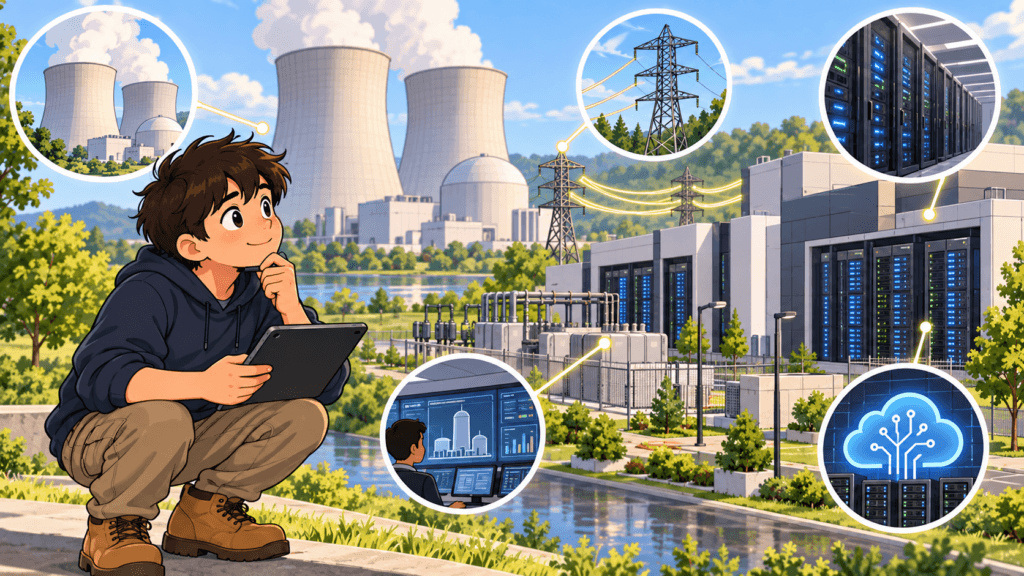
From my experience in electrical construction, I think the AI-SMR story is bigger than choosing one reactor design.
A 500 MW or 1 GW nuclear-powered data center ecosystem also requires:
- High-voltage substations
- Transformers
- Switchgear
- Protection systems
- Transmission
- Backup systems
- Cooling infrastructure
- Large cable systems
- Grid interconnection equipment
That’s why I’m interested in both companies even though their commercialization paths are different.
AI is creating demand for something utilities and technology companies increasingly value:
large amounts of firm electricity available 24/7.
If SMRs can eventually deliver that electricity competitively, the addressable market could be enormous.
But first, someone has to actually build them.
Oklo vs NuScale: Which Has the Stronger AI Story in 2026?
If I separate the two companies strictly by what has been demonstrated so far:
Oklo currently has the stronger direct AI data center story.
Its Meta agreement gives it a named Big Tech customer supporting up to 1.2 GW of nuclear development.
NuScale currently has the stronger reactor regulatory maturity story.
Its designs have progressed further through NRC review, and its ENTRA1-TVA program could potentially reach an enormous 6 GW if it converts into definitive projects.
So I would not reduce the comparison to:
OKLO good / SMR bad
or the reverse.
The more useful framework is:
Oklo → customer validation + AI exposure
NuScale → design approval + scale potential
And over the next few years, the company that turns those advantages into licensed, financed and operating reactors will matter much more than whichever stock currently has the stronger AI narrative.
This article is for informational purposes only and is not investment advice.
Is there something you’d like to see?
Suggest an electrical topic, practical guide, or calculator you would like to see on JHOTAS-LAB. Your suggestion may help shape future content.