
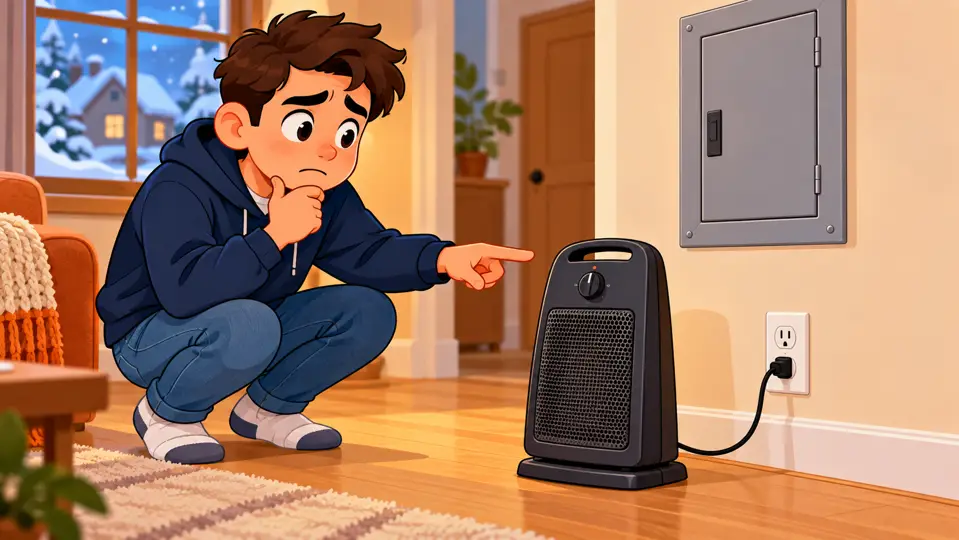
If your space heater keeps tripping the breaker, stop repeatedly resetting it. The heater may share a circuit with other loads, have a defect, or expose a wiring problem. A 1,500-watt heater draws about 12.5 amps at 120 volts, so a seemingly small extra appliance can matter. Trip timing helps describe the problem, but it does not establish the cause.
Switch the heater off. If there is smoke, active sparking, a burning smell or a hot, damaged outlet, keep clear and get appropriate emergency help. Do not handle a hot or damaged plug. Leave the equipment out of use until the problem is assessed.
First Separate a Heater Shutdown From a Breaker Trip
Some heaters shut themselves down through a tip-over switch or internal temperature protection. If the room lights and other devices still work and the circuit breaker has not operated, the heater may have stopped internally. Follow its manual rather than treating every shutdown as a house-wiring fault.
If multiple outlets lose power, identify the protective device involved without opening any electrical covers. A breaker, an upstream GFCI outlet and the heater’s own protection serve different purposes. Record which one operated and any externally visible indicator. Our breaker-trip checklist explains the wider first checks.
Related reading: when a circuit breaker needs replacement.
Why 1,500 Watts Can Crowd a Shared Circuit
For this resistive-load example, current is watts divided by volts: 1,500 ÷ 120 = 12.5 amps. Add a hypothetical 600-watt appliance on the same 120-volt circuit and the combined current becomes 2,100 ÷ 120 = 17.5 amps. That exceeds a 15-amp circuit’s rating.
| Illustrative simultaneous load | Power | Current at 120V |
|---|---|---|
| Heater alone | 1,500W | 12.5A |
| Heater + 100W of other loads | 1,600W | 13.33A |
| Heater + 600W appliance | 2,100W | 17.5A |
These calculations explain loading; they do not certify an installation or predict an exact trip time. Breakers do not all open at a single identical threshold or delay. Applicable continuous-load rules, equipment instructions, conductor condition and the actual protective device must also be considered.
A different wall outlet is not necessarily a different circuit. Adjacent rooms can share wiring, and the second socket in a duplex outlet does not provide a separate supply. If you need to understand the layout, see how to identify which breaker controls an outlet without removing covers.
What the Trip Pattern Can Tell You
| Observed pattern | Useful information to record | Next step |
|---|---|---|
| Trip after sustained heater use | Other appliances running and approximate elapsed time | Review shared loading with a qualified electrician if it recurs |
| Trip when another appliance starts | Which appliance and whether it shares the circuit | Stop that combination; verify circuit arrangement |
| Immediate or repeated trip | Heater model, cord condition and breaker indicator | Stop using the heater and have the fault assessed |
| Heater stops, house circuit stays on | Heater error light, placement and manual instructions | Follow manufacturer troubleshooting; do not defeat protection |
An immediate trip is not proof of a bad breaker. A delayed trip is not proof that everything except total wattage is healthy. Depending on the device, protection may respond to overload, a short circuit, ground leakage or an arcing condition. Do not replace an AFCI or GFCI device with ordinary protection to make the symptom disappear.
A Hot Plug Changes the Decision
An outlet connection can overheat locally even when the total circuit current has not made the breaker trip. Stop using an outlet that is hot, loose, discolored, buzzing or smells burnt. A heater running successfully for a few minutes does not prove the connection is sound.
Connect a portable heater directly to a suitable wall outlet as its instructions require. Extension cords, power strips and plug adapters are not a solution to repeated trips. Keep the required clearance from combustible materials, and turn the heater off when unattended or sleeping.
Related reading: power strip capacity and total wattage.
Will Low Heat Solve It?
A lower-power setting reduces current only if the heater actually reduces its electrical input. For an illustrative 750-watt setting, 750 ÷ 120 = 6.25 amps. Check the label or manual; a thermostat setting that cycles a 1,500-watt element still draws its full operating current while that element is on.
Reduced power does not repair a damaged heater, loose receptacle or wiring fault. If a heater has already caused repeated trips or abnormal heating, stop using it until assessed. Do not keep moving a suspected faulty appliance around the house to test it.
For the separate question of running cost, compare a space heater with central heating before adding more heaters. A lower bill does not establish that a circuit or receptacle is safe.
What to Ask an Electrician
Provide the heater’s rated watts, breaker rating, trip pattern and list of simultaneous loads. Ask whether the issue is shared loading, an appliance fault, receptacle condition or circuit wiring, and whether a properly designed additional circuit is appropriate. A larger breaker requires a compatible circuit design; swapping one in is not a shortcut.
For the separate electricity-bill question, use our 1,500-watt heater running-cost guide. Electrical capacity and operating cost are different questions: the first concerns instantaneous demand and protection; the second depends on energy consumed over time.
About the Author
JHOTAS-LAB is written by an electrical-construction and project-coordination practitioner in South Korea. This U.S.-focused guide combines official documentation with clearly stated calculation assumptions; it does not describe personal U.S. installation experience.
Sources & Official References
CPSC — Reducing Fire Hazards for Portable Electric Heaters
ESFI — Space Heater Safety Tips
EIA — Measuring Electricity
Is there something you’d like to see?
Suggest an electrical topic, practical guide, or calculator you would like to see on JHOTAS-LAB. Your suggestion may help shape future content.