
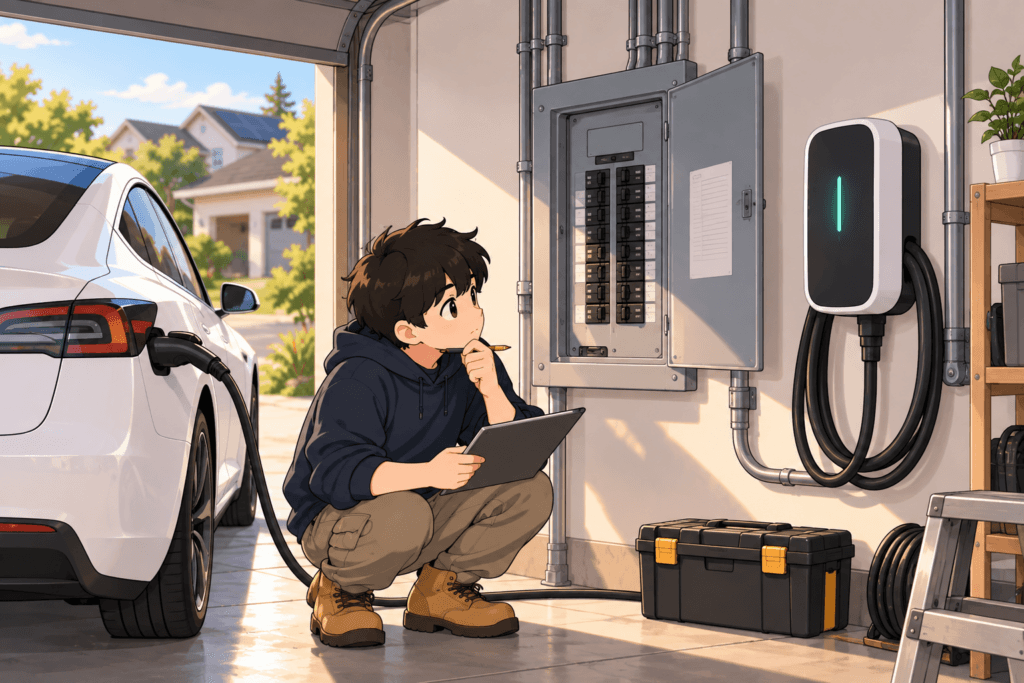
Installing an EV charger at home is not simply a matter of mounting a charger on the garage wall.
Before installing a Level 2 EV charger, your home’s electrical system needs enough service capacity, an appropriately sized dedicated circuit, the correct breaker and wiring, and a suitable location for the charging equipment.
Some homes are already ready.
Others may need a new circuit.
And some older homes may need a panel or electrical service upgrade before a higher-power charger can be installed safely.
That is why I think the electrical inspection should come before choosing the biggest charger available.
Level 1 vs. Level 2 Home Charging
Most home EV charging falls into two categories.
Level 1 charging generally uses a standard 120-volt household circuit.
It is slower but may be enough for drivers who travel relatively short distances each day.
Level 2 charging normally uses 240 volts and provides significantly faster charging.
The U.S. Department of Energy’s Alternative Fuels Data Center notes that many EV owners can meet their daily driving needs with Level 1 charging, provided a suitable dedicated branch circuit is available. Level 2 equipment uses 240-volt power and is commonly installed when faster charging is needed.
For most homeowners asking about EV charger installation, Level 2 is where the electrical system becomes especially important.
1. Check Your Electrical Service Capacity First
Before adding a charger, the first question should be:
Can the existing electrical service support the additional load?
A home may already have:
- Central air conditioning
- Electric range
- Clothes dryer
- Electric water heater
- Heat pump
- Hot tub
- Solar or battery equipment
Adding a high-power EV charger on top of those loads can significantly change the home’s electrical demand.
ESFI recommends having a qualified electrician assess the home’s electrical service, panel, and wiring before EV charging equipment is installed.
A 100-amp service does not automatically mean an EV charger cannot be installed.
Likewise, having a 200-amp service does not automatically mean any size charger can be added.
The actual load calculation matters.
2. Level 2 Chargers Usually Need a Dedicated 240V Circuit
A Level 2 EV charger should not simply be added to a circuit already serving other appliances.
Home EV charging generally requires a dedicated branch circuit sized for the charging equipment.
ESFI specifically recommends a dedicated circuit for residential EV charging and advises homeowners to have a qualified electrician install the equipment.
That circuit may include:
- A two-pole circuit breaker
- Properly sized conductors
- Grounding
- A receptacle or hardwired connection
- Required protection equipment
The exact design depends on the charger rating and local electrical code.
3. Charger Amperage Determines Circuit Size
This is where homeowners sometimes get confused.
The number printed on the circuit breaker is not necessarily the same as the charger’s continuous output.
EV charging is generally treated as a continuous electrical load.
Current NEC requirements call for branch-circuit and feeder overcurrent protection supplying EV charging equipment to be sized at not less than 125% of the maximum continuous load.
For example, a simplified comparison looks like this:
| EV Charger Output | Typical Minimum Circuit Rating* |
|---|---|
| 24A | 30A |
| 32A | 40A |
| 40A | 50A |
| 48A | 60A |
*Examples based on the 125% continuous-load principle. Actual installation requirements depend on the equipment, wiring method, local code, and authority having jurisdiction.
This is why simply buying a 48-amp charger does not mean every home can immediately operate it at 48 amps.
The entire circuit has to support that load.
4. Do You Need a 200-Amp Panel Upgrade?
Not necessarily.
This connects directly to the question I discussed in my electrical panel upgrade guide.
A homeowner may have a 100-amp service and still have enough calculated capacity for an EV charger.
Another home with many electric appliances may not.
Possible solutions can include:
- Installing a lower-power charger
- Reducing the charger’s configured maximum current
- Using an EV energy-management system
- Upgrading the electrical panel
- Upgrading the entire electrical service
ESFI’s consumer research found that many surveyed EV owners needed some form of panel upgrade when preparing their homes for charging, which shows why checking capacity before installation matters.
But I would not upgrade a panel automatically just because an EV is being purchased.
Do the load calculation first.
5. Panel Space Matters Too
Even if the home has enough overall electrical capacity, the panel still needs room for the new circuit.
A Level 2 charger usually requires a two-pole breaker.
If the panel is already full, an electrician may need to evaluate alternatives such as:
- Adding a subpanel
- Reconfiguring circuits
- Using approved breaker arrangements
- Replacing the panel
Panel space and electrical capacity are two different issues.
A panel can be physically full while still having available service capacity.
6. Charger Location Changes Installation Cost
The distance between the electrical panel and the parking location can make a major difference.
If the panel is inside the garage and the charger is mounted a few feet away, the installation may be relatively simple.
If wiring must run across the house, through finished walls, underground, or to a detached garage, the project becomes more complicated.
Longer cable runs mean more conductor, conduit, labor, and potentially larger conductors depending on the design.
Outdoor installations also require equipment rated for the environment. The Department of Energy and ESFI both note that outdoor charging is possible when properly rated equipment is used.
7. Do Not Use an Extension Cord
This one is simple.
Do not use a household extension cord to charge an EV.
EV charging can place a substantial electrical load on a circuit for many hours.
ESFI specifically warns against extension cords and multiplug adapters for EV charging because of fire and shock risks.
Use approved charging equipment and have the electrical installation designed for that load.
My View From the Electrical Construction Side
From my perspective working around electrical systems, I think people often start this process in the wrong order.
They first ask:
“Which EV charger should I buy?”
I would start with:
“What can my electrical system safely supply?”
Then choose the charger.
A 48-amp charger may sound better than a 32-amp charger, but faster charging is not automatically necessary.
If a car sits in the garage for eight or ten hours every night, a lower charging rate may still restore more than enough range for normal daily driving.
Sometimes spending thousands of dollars on an electrical service upgrade just to reduce charging time slightly may not make economic sense.
Other households genuinely need the additional capacity.
The point is that charger size should match the vehicle, driving habits, and electrical system.
Final Thoughts
Before installing a Level 2 EV charger, check five things:
Electrical service capacity
Panel condition and breaker space
Dedicated 240V circuit
Correct breaker and conductor sizing
Distance from the panel to the charging location
If those pieces work together, home charging can be simple and convenient.
If they do not, the project may require load management, panel work, or a full service upgrade.
That is why I would treat an EV charger as part of the home’s electrical system — not just another appliance you plug in.
The best EV charger is not necessarily the most powerful one.
It is the one your home can safely support while still meeting your actual charging needs.
Is there something you’d like to see?
Suggest an electrical topic, practical guide, or calculator you would like to see on JHOTAS-LAB. Your suggestion may help shape future content.