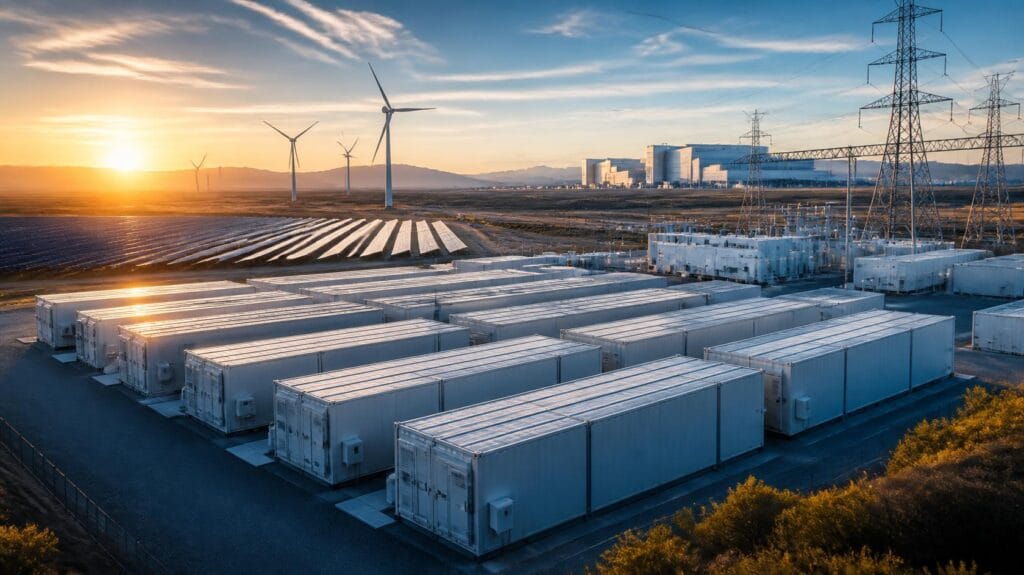

AI data centers are not the only reason electricity bills are rising, but their rapidly growing power demand is becoming an important part of the cost debate—especially in Virginia.
Virginia regulators are now changing the way some of the grid infrastructure required by large electricity users is paid for. The goal is straightforward: if a new data center creates the need for a new transmission line, substation, or other major grid upgrade, ordinary households should not automatically be left paying part of that bill.
That question matters far beyond Virginia.
As artificial intelligence expands across the United States, data centers are becoming some of the largest new electricity customers utilities have seen in decades.
Why Virginia Is at the Center of the AI Power Debate
Northern Virginia contains one of the largest concentrations of data centers in the world.
These facilities support cloud computing, internet services and increasingly power-hungry artificial intelligence workloads.
A hyperscale data center can require tens or even hundreds of megawatts of electrical capacity. At that scale, supplying electricity is no longer simply a matter of connecting another building to a distribution feeder.
Utilities may need additional substations, high-voltage transmission lines, transformers and generation capacity.
Virginia’s State Corporation Commission has said that large-load customers such as hyperscale data centers are a major reason it has introduced new safeguards designed to prevent infrastructure costs from shifting to other customers.
This is the real issue behind the debate:
Who pays for the electrical infrastructure needed to support the AI boom?
Could Data Centers Actually Raise Household Electricity Bills?
Potentially, yes—but the relationship is not as simple as saying that every new AI data center directly increases your monthly bill.
Electricity rates contain several different costs.
Customers ultimately pay for things such as:
- electricity generation,
- transmission,
- local distribution,
- fuel,
- grid maintenance,
- and new infrastructure.
When electricity demand grows quickly, utilities may need to build expensive infrastructure earlier than expected.
If those costs are spread across the entire customer base, households and small businesses can end up paying part of the cost even when a large industrial customer was the primary reason the project was needed.
That is the type of “cost shifting” Virginia regulators are trying to limit.
In a recent transmission-cost proceeding, Dominion Energy initially estimated that changes to its Rider T1 transmission charge could increase the bill of a typical residential customer using 1,000 kWh by about $2.90 per month.
After updated calculations and changes to how large-load customers are treated, that projected increase fell to about $0.94 per month.
That difference shows why cost-allocation rules matter.
Virginia Is Making Large Power Users Pay More of Their Own Costs
The Virginia SCC has already created a new electricity rate class known as GS-5 for very large electricity users.
The class applies to customers meeting large-load thresholds, including many hyperscale data centers.
Beginning January 1, 2027, qualifying customers will face several new requirements.
Large-load customers can be required to commit to electric service for at least 14 years and pay at least 85% of the transmission and distribution capacity reserved for them, even if they ultimately use less electricity than expected.
The rules are designed to reduce the risk that utilities build expensive infrastructure for a huge proposed project only to have that project use much less electricity—or never fully materialize.
This has become particularly important as utilities across the United States receive enormous power requests from proposed AI and data center developments.
Some of those projects may never be built.
The New Fight Is About Transmission Lines
Virginia regulators have now gone another step.
The SCC approved a framework requiring changes to Dominion Energy’s line-extension policy so that certain direct-connect transmission facilities can be paid for directly by the large-load customer that caused them to be built.
In simple terms:
If a massive data center needs a transmission facility that otherwise would not have been necessary, regulators increasingly want the customer creating that demand to pay for it.
The SCC says the policy will apply prospectively to direct-connect facilities needed for new or expanding large loads.
Major technology companies including Microsoft, Google, Amazon and Meta participated in Virginia’s debate over how these transmission costs should be allocated.
Industry representatives have argued that data centers already pay substantial electricity and infrastructure costs and that changing allocation methods too quickly could create uncertainty for development.
Consumer advocates and state officials, meanwhile, argue that residential customers should not subsidize infrastructure built primarily for extremely large commercial loads.
Why AI Changes the Electrical System So Quickly
From an electrical infrastructure perspective, the problem is not simply that AI servers consume a lot of kilowatt-hours.
The bigger challenge is power density and scale.
A new residential development might gradually add electrical load as homes are constructed and occupied.
A hyperscale data center can request hundreds of megawatts at a single location.
That can require:
- new high-voltage transmission capacity,
- larger substations,
- additional transformers,
- new generation resources,
- backup power systems,
- and major upgrades to grid protection and control systems.
The grid therefore has to be designed for the capacity the customer may demand—not simply the electricity it happened to consume last month.
This is why minimum-demand charges and long-term contracts are becoming an important part of data center electricity regulation.
This Is Not Just a Virginia Problem
The same issue is spreading across the United States.
PJM Interconnection, which operates the grid across Virginia and parts of 12 other states plus Washington, D.C., has been dealing with rapidly rising demand from data centers.
During the first half of 2026, congestion costs on PJM’s transmission system reached about $6 billion, up 43%, with Northern Virginia among the areas experiencing significant transmission constraints.
Texas has faced another problem: proposed data center projects requesting enormous amounts of electricity before regulators know how many of those projects will actually be built.
That phenomenon is increasingly described as “ghost demand.”
It makes grid planning even harder because utilities risk building billions of dollars of infrastructure for loads that might never appear.
So, Are AI Data Centers Raising Your Electricity Bill?
The most accurate answer is:
They can contribute to higher electricity costs, but data centers are only one part of the equation.
Fuel prices, aging infrastructure, transmission congestion, generation investment, extreme weather and utility regulation also affect electricity rates.
What is changing is the scale of AI-driven electricity demand.
Virginia’s response gives us an early look at what other states may eventually do: create special large-load rate classes, require long-term commitments and make data centers directly fund more of the infrastructure they cause utilities to build.
For homeowners, that could ultimately be good news.
AI may require enormous amounts of electricity, but the growing regulatory principle is becoming much clearer:
The customers creating extraordinary grid costs should pay an appropriate share of those costs rather than automatically passing them on to everyone else.
Is there something you’d like to see?
Suggest an electrical topic, practical guide, or calculator you would like to see on JHOTAS-LAB. Your suggestion may help shape future content.