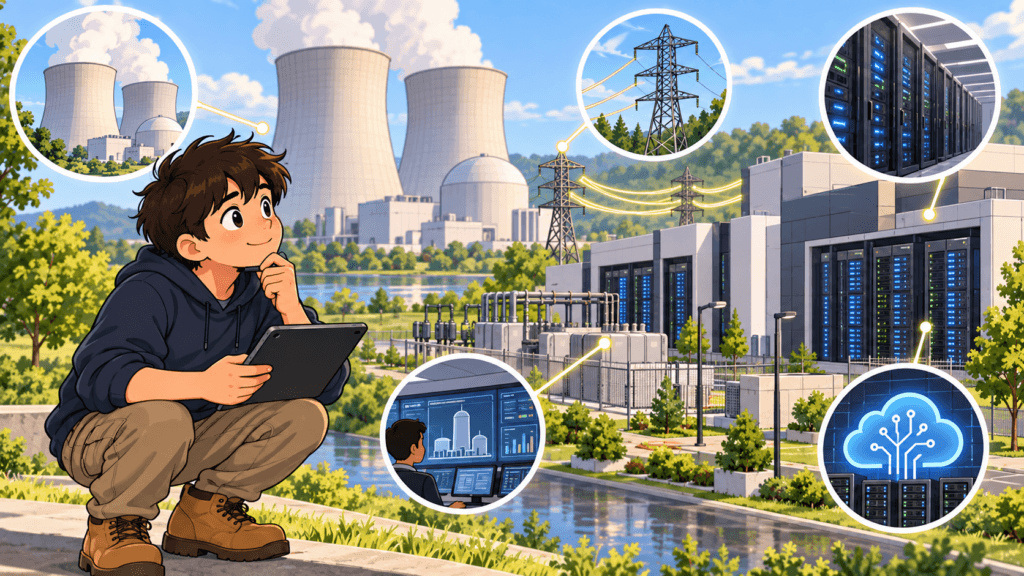
AI is creating a new investment narrative around nuclear energy.
But investors should be careful.
Not every nuclear or SMR company being called an “AI nuclear stock” actually has a signed data center energy agreement.
As of September 2026, several publicly traded U.S. companies have concrete agreements involving Microsoft, Google, Meta, or Amazon.
Others are developing technology specifically for AI data centers but do not yet have the same type of named hyperscaler contract.
That distinction matters.
Here are five publicly traded companies with some of the clearest real-world connections between nuclear power and AI data center demand.
AI Nuclear Stocks With Actual Data Center Deals
| Company | Ticker | Tech Partner | Nuclear Connection |
|---|---|---|---|
| Constellation Energy | CEG | Microsoft / Meta | Existing nuclear + reactor restart |
| NextEra Energy | NEE | Duane Arnold restart | |
| Vistra | VST | Meta | Existing reactors + uprates |
| Talen Energy | TLN | Amazon AWS | Susquehanna nuclear PPA |
| Oklo | OKLO | Meta | Advanced nuclear development |
The important point is that these agreements are not all equivalent.
Some involve operating nuclear plants generating electricity today.
Others involve restarting retired reactors.
And Oklo represents a much earlier-stage advanced nuclear development story.
1. Constellation Energy (CEG): Microsoft and Meta
Constellation has one of the clearest links between existing U.S. nuclear assets and Big Tech electricity demand.
Microsoft signed a 20-year power purchase agreement supporting the restart of the former Three Mile Island Unit 1, now known as the Crane Clean Energy Center.
The project is expected to restore approximately 835 MW of nuclear generation, subject to the required regulatory approvals. Microsoft will purchase the energy to help match electricity consumed by its data centers in the PJM region.
Constellation also has another major technology customer.
Meta signed a 20-year nuclear energy agreement supporting continued operation of Constellation’s Clinton Clean Energy Center in Illinois.
The agreement, beginning in 2027, covers 1,121 MW and supports an additional 30 MW of capacity.
That makes CEG different from many speculative advanced-nuclear names.
Its AI exposure is connected to large existing nuclear assets and contracted power, not just future reactor concepts.
2. NextEra Energy (NEE): Google’s Nuclear Restart
NextEra Energy now has one of the newest major AI-nuclear deals.
Google signed a 25-year agreement supporting the restart of Iowa’s Duane Arnold Energy Center.
The nuclear plant has approximately 615 MW of capacity and is targeted to return to service by the first quarter of 2029, pending regulatory approval. Google says the electricity will support its expanding cloud and AI infrastructure in Iowa.
The project became even more significant on September 8, 2026, when NextEra secured a U.S. Department of Energy loan of up to $1.9 billion to help finance the restart.
For investors, though, NEE should not be viewed as a pure AI-nuclear stock.
NextEra is a huge diversified electricity and energy company.
The Google deal is important, but nuclear data centers represent only one piece of a much larger business.
3. Vistra (VST): More Than 2.6 GW Linked to Meta
Vistra may be one of the more interesting existing-nuclear plays in this group.
In January 2026, Meta and Vistra announced 20-year agreements connected to three nuclear plants:
Perry and Davis-Besse in Ohio, and Beaver Valley in Pennsylvania.
Meta is purchasing 2,176 MW from the operating Perry and Davis-Besse plants.
It is also supporting 433 MW of additional capacity through reactor uprates across Perry, Davis-Besse, and Beaver Valley.
Together, the agreements cover 2,609 MW of nuclear power, with purchases beginning in late 2026 and the additional capacity expected to ramp through 2034.
That’s an important distinction from building a brand-new reactor.
Vistra already owns operating nuclear assets.
The AI opportunity here is partially about keeping existing plants operating longer and extracting additional generation from them.
4. Talen Energy (TLN): Amazon AWS and Susquehanna
Talen Energy has perhaps the most direct data-center relationship on this list.
Talen’s Susquehanna nuclear facility in Pennsylvania supplies power connected to Amazon Web Services’ data center operations.
In June 2025, Talen expanded its relationship with Amazon through a PPA that can eventually provide AWS with up to 1,920 MW of carbon-free nuclear power through 2042, with extension options.
The power supports Amazon operations involving AI and cloud technologies at its nearby data center campus and potentially other Pennsylvania sites.
Talen and Amazon are also exploring:
SMRs + nuclear uprates
within Talen’s Pennsylvania footprint.
That combination makes TLN particularly interesting from an infrastructure perspective:
existing nuclear → immediate AI demand → possible future advanced nuclear expansion.
5. Oklo (OKLO): The Higher-Risk Advanced Nuclear Play
Oklo is very different from the previous four.
It does not have a large operating nuclear fleet.
Instead, it is developing advanced Aurora nuclear powerhouses.
In January 2026, Oklo and Meta announced an agreement supporting development of a nuclear campus in southern Ohio that could eventually reach 1.2 GW.
The project is intended to support Meta’s regional data centers, and the agreement gives Meta a mechanism to provide prepayments that can help Oklo secure fuel and advance development.
This is why OKLO receives so much attention when investors discuss AI nuclear stocks.
The potential upside is large if advanced reactors become a major source of dedicated data center power.
But the risk profile is also completely different.
Oklo still has to move through development, licensing, fuel procurement, construction, and eventual commercial operation.
So an Oklo-Meta development agreement should not be treated as equivalent to an operating nuclear plant already selling electricity under a PPA.
That distinction matters enormously.
What About NuScale Power (SMR)?
This is where the story gets interesting.
NuScale absolutely wants the AI data center market.
Its partner ENTRA1 Energy specifically markets NuScale SMRs as a source of behind-the-meter power for hyperscale AI facilities, including configurations offering up to 924 MW of continuous generation.
NuScale also says ENTRA1 can offer long-term power arrangements specifically to data center customers.
But based on the public information I can verify as of September 2026, I would not put NuScale in the same category as CEG-Microsoft, NEE-Google, TLN-Amazon, or OKLO-Meta yet.
NuScale’s major U.S. commercialization effort currently involves ENTRA1 discussions with TVA over a potential multi-gigawatt deployment program.
That is significant.
But there is a difference between:
“Our technology is designed for AI data centers”
and
“Microsoft/Google/Meta/Amazon has signed a named power agreement with us.”
For an investor researching SMR stocks, that’s exactly the type of distinction worth watching.
Private Companies Matter Too
Some of the biggest AI-nuclear projects cannot currently be purchased directly through the stock market.
Google is working with privately held Kairos Power, including a TVA agreement that will deliver the first 50 MW from an advanced reactor toward Google’s data center electricity demand, with a broader collaboration targeting up to 500 MW.
Amazon has invested $500 million in X-energy and is supporting SMR development that could eventually exceed 5 GW in the United States.
Meta also has an agreement with privately held TerraPower, potentially supporting up to 2.8 GW of Natrium nuclear capacity.
So the public-stock universe does not represent the entire AI nuclear market.
My View From the Electrical Infrastructure Side
From my experience in electrical construction, I think the biggest mistake is treating all these companies as one identical “AI nuclear” trade.
They are completely different businesses.
CEG, VST, NEE and TLN already have large-scale electrical generation assets.
OKLO represents new advanced nuclear development.
SMR has an NRC-approved reactor design and is actively targeting data centers, but commercialization and customer conversion remain key questions.
From the electrical side, however, they all benefit from the same underlying problem:
AI requires enormous amounts of dependable power.
And nuclear projects also create demand for transformers, switchgear, protection systems, cables, substations, transmission and other electrical infrastructure.
The opportunity is therefore much larger than just the reactor itself.
Final Thoughts: Which AI Nuclear Stocks Actually Have Deals?
If the standard is simply “Does this publicly traded company have a named Big Tech nuclear agreement?”, the clearest 2026 examples are:
CEG → Microsoft + Meta
NEE → Google
VST → Meta
TLN → Amazon AWS
OKLO → Meta
NuScale remains highly relevant to the AI-SMR theme, but I would currently classify it as data-center positioning and potential future contracting, rather than putting it in exactly the same bucket as companies with named hyperscaler nuclear agreements.
And that may be the most important lesson for investors.
AI nuclear stocks are no longer just a theme. Real contracts are appearing—but the quality, timing, and execution risk behind those contracts vary enormously.
For anyone researching the sector, the next question should not simply be:
“Which nuclear stock could benefit from AI?”
It should be:
“Who already has a customer, how much power is contracted, and when can that electricity actually be delivered?”
This article is for informational purposes only and is not investment advice.
Is there something you’d like to see?
Suggest an electrical topic, practical guide, or calculator you would like to see on JHOTAS-LAB. Your suggestion may help shape future content.