
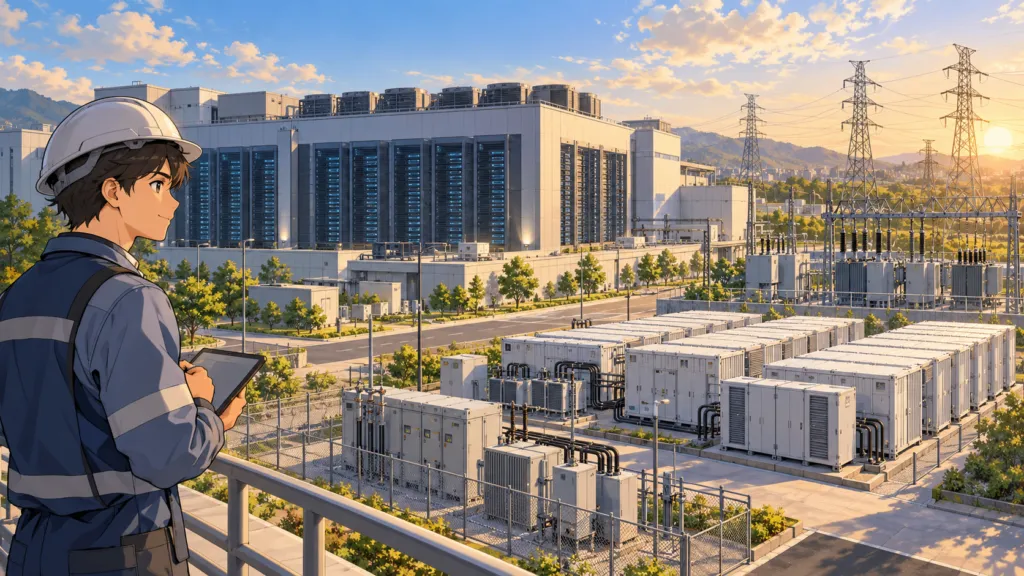
AI data centers are creating a difficult problem for electric utilities.
The issue is not only how much electricity they consume over a year. A new campus may require hundreds of megawatts of capacity to be available whenever the facility needs it.
That can mean new substations, transformers, transmission upgrades and additional generation.
Data center battery storage can reduce some of that pressure.
A battery energy storage system, or BESS, can temporarily reduce how much power a data center draws from the grid, shift electricity use away from expensive hours and provide fast backup during disturbances.
But batteries have an important limitation.
They store electricity.
They do not create it.
That distinction determines which data center grid costs BESS can reduce — and which ones it cannot.
Why Data Center Grid Costs Are Becoming a Bigger Issue
U.S. data center electricity consumption is rising rapidly.
Lawrence Berkeley National Laboratory’s 2026 update estimates that data centers could account for about 11.8% of total U.S. electricity consumption by 2030 under its central scenario.
For utilities, the challenge is often concentrated in specific locations.
A 300 MW data center does not spread that electricity demand evenly across the country. It may require hundreds of megawatts at one substation or transmission area.
Serving that load may require:
- larger substations,
- additional transformers,
- transmission upgrades,
- new generation capacity,
- protection-system changes,
- and additional reliability reserves.
Battery storage can change the facility’s load profile seen by the grid.
That can be valuable.
1. BESS Can Reduce Peak Grid Demand
Peak shaving is one of the clearest uses of battery storage.
Suppose a data center normally draws 80 MW from the grid but occasionally rises to 100 MW.
A sufficiently large battery could discharge during those high-demand periods and keep the grid connection closer to 80 MW.
The servers may still consume 100 MW.
The difference is that part of the power temporarily comes from the battery rather than the utility.
From the grid’s perspective:
100 MW facility demand
− 20 MW battery discharge
= 80 MW grid demand
This can reduce peak-demand charges where utility tariffs include them.
More importantly for very large facilities, it may reduce how much capacity the utility needs to reserve for short-duration peaks.
DOE guidance on BESS specifically identifies peak shaving, electricity-bill optimization and deferral of some grid investments as potential storage applications.
2. Battery Storage May Help Defer Some Grid Upgrades
This is where the data center discussion gets more interesting.
Utilities normally have to plan for the amount of electricity a customer may withdraw from the grid.
If a new facility requests 300 MW of firm service, the grid may need infrastructure capable of reliably supplying that level.
But imagine that the data center agrees that its grid withdrawal will never exceed 250 MW during certain constrained periods.
Battery storage could help maintain that limit.
Instead of designing every component around the unrestricted peak, planners may be able to study the facility as a more flexible load.
That does not mean adding batteries automatically eliminates a transmission project.
The operating limit has to be dependable, enforceable and included in the utility or transmission-service agreement.
Grid planners cannot simply assume a battery will always be charged when the system needs it.
Flexible Interconnection Is Becoming More Important
This concept is now appearing directly in U.S. grid regulation.
In June 2026, FERC directed regional grid operators to examine or reform how very large loads such as data centers connect to the transmission system.
One of the approaches receiving attention is flexible transmission service.
Under this model, a large customer may accept limits on how much electricity it can withdraw from the grid during certain conditions.
That flexibility can reduce the need for some Network Upgrades and generation capacity compared with serving the same customer as a completely firm load.
A BESS can help a data center meet those restrictions without immediately reducing its internal computing load.
That creates an interesting combination:
Grid limit → battery discharges → servers continue operating → grid withdrawal falls
This could help some projects connect faster where transmission capacity is limited.
“👉 Battery storage is only one form of flexibility. Read Can AI Data Centers Reduce Power Use When the Grid Is Stressed? to see how workload shifting, storage and onsite generation can work together.”
3. BESS Can Shift Electricity to Cheaper Hours
A battery can also move electricity consumption through time.
If electricity prices are lower overnight or during periods of abundant generation, the BESS can charge then.
Later, when grid prices or system demand rise, it can discharge.
This is energy shifting.
For a large data center operating under time-varying electricity prices, the difference between charging and discharging periods can create operating savings.
The same strategy can also reduce pressure on the grid during peak hours.
But there is a catch.
The battery eventually has to recharge.
BESS does not eliminate electricity consumption. It moves part of that consumption to another time.
There are also conversion losses, meaning slightly more electricity must be used to recharge the battery than the amount later delivered.
4. Batteries Can Provide Fast Backup and Power Quality Support
Data centers already place enormous value on power reliability.
Even a very short electrical disturbance can cause UPS systems and protection equipment to react.
BESS can respond extremely quickly.
It can help bridge short interruptions, support microgrid operation and provide power while another onsite generation source starts.
DOE is already supporting work involving microgrids at major data center facilities in Virginia and South Carolina that includes expanded onsite generation and battery energy storage.
That shows the role of BESS is becoming broader than simply lowering the electric bill.
Storage can become part of the facility’s reliability architecture.
What Battery Storage Cannot Do
The biggest mistake is treating BESS as a replacement for the electricity system needed to serve a data center.
It is not.
BESS Cannot Generate Electricity
If a 200 MW data center operates continuously, it requires approximately 200 MW of power continuously.
A battery can supply part of that demand temporarily.
But the energy stored inside eventually runs out.
For example, consider a simplified:
20 MW / 80 MWh BESS
It could theoretically supply 20 MW for about four hours before its usable stored energy is exhausted.
Afterward, the facility still needs electricity.
The battery also needs to recharge.
That is very different from adding a 20 MW generator capable of producing energy as long as fuel or another energy source remains available.
BESS Cannot Automatically Eliminate Transmission Upgrades
A battery may reduce peak demand and therefore reduce the size or urgency of some upgrades.
But many transmission constraints are not caused by only a few peak hours.
A hyperscale data center running close to full load around the clock can create a persistent capacity requirement.
If the local transmission system can deliver only 150 MW and a campus continuously needs 300 MW, a four-hour battery does not solve the underlying 150 MW shortage.
New transmission, generation or other infrastructure may still be necessary.
A Flat 24/7 Load Is Harder to Peak-Shave
Battery economics are usually strongest when a facility has noticeable peaks and valleys in its electricity use.
Data centers can be different.
Some hyperscale facilities operate at relatively high load factors for long periods.
If electricity demand remains near 200 MW all day, there may be little low-demand period available for conventional peak shaving.
Storage can still provide grid services, backup power and demand flexibility.
But the value proposition becomes different from a commercial building that has a short afternoon peak.
Backup Power and Grid Flexibility Can Compete
There is another practical trade-off.
A battery cannot simultaneously use the same stored energy for every purpose.
If a data center reserves most of its battery capacity for emergency backup, less capacity may be available for:
- peak shaving,
- demand response,
- energy arbitrage,
- or flexible interconnection.
If operators use most of the battery every day to reduce grid demand, less stored energy may remain available when an unexpected outage occurs.
The system therefore has to be designed around priorities.
Reliability requirements normally come first for mission-critical facilities.
My View From the Electrical Construction Side
From an electrical construction perspective, installing BESS beside a data center is not simply a matter of placing battery containers on the site.
A large system also requires power conversion equipment, transformers, switchgear, protection systems, cables, controls, fire protection and a properly engineered connection to the facility and utility grid.
The electrical design becomes even more important if the battery is expected to control the maximum power flowing through the point of interconnection.
The utility needs confidence that the system will actually respond when required.
That means controls, protection, telemetry and operating agreements matter just as much as battery capacity.
“👉 For the broader storage picture, see How Much Battery Storage Does the U.S. Have in 2026? for why utility-scale BESS has already passed 50 GW in the United States.”
So Can BESS Reduce Data Center Grid Costs?
Yes, in the right configuration.
Battery storage can reduce peak demand, shift electricity use, support demand response and potentially reduce or defer some infrastructure upgrades.
Flexible grid-service agreements may make those capabilities even more valuable for large data centers trying to connect in constrained regions.
But BESS cannot turn a continuously operating 300 MW data center into a facility that no longer needs 300 MW of energy supply.
It cannot create electricity.
It cannot solve every transmission bottleneck.
And it cannot provide unlimited backup duration.
The strongest role for BESS is therefore not replacing the grid.
It is making the data center’s interaction with the grid more controllable.
For utilities facing rapid AI-driven load growth, that flexibility may become almost as important as the battery’s stored energy itself.
Sources & Official References
Lawrence Berkeley National Laboratory — Integrating AI Data Centers with the Power Grid
Energy storage is one of the four main flexibility mechanisms identified for data centers, alongside computational flexibility, facility infrastructure and onsite generation.
Official LBNL source
Lawrence Berkeley National Laboratory — U.S. Data Center Energy Usage Report: 2025 Update
The 2026 report estimates a central 2030 data-center electricity share of 11.8%, with a modeled range of 9.5%–15.3%. LBL ETA Publications
Official LBNL report
Federal Energy Regulatory Commission — Large Load Show Cause Orders, June 18, 2026
FERC described flexible transmission service as a way large loads may reduce Network Upgrade and generation-capacity requirements when they can reliably limit grid withdrawals. Federal Energy Regulatory Commission
Official FERC source
U.S. Department of Energy / FEMP — Battery Energy Storage Systems: Considerations for Implementation
DOE materials identify peak shaving, energy shifting, backup power, bill optimization and potential grid-investment deferral among BESS applications. The Department of Energy’s Energy.gov
Official DOE BESS guide
U.S. Department of Energy — Data Center Flexibility as a Grid Enhancing Technology
The 2026 project includes microgrid development and expanded battery energy storage at data center sites in Virginia and South Carolina. The Department of Energy’s Energy.gov
Official DOE project page
Sources checked: October 2, 2026.
Is there something you’d like to see?
Suggest an electrical topic, practical guide, or calculator you would like to see on JHOTAS-LAB. Your suggestion may help shape future content.