
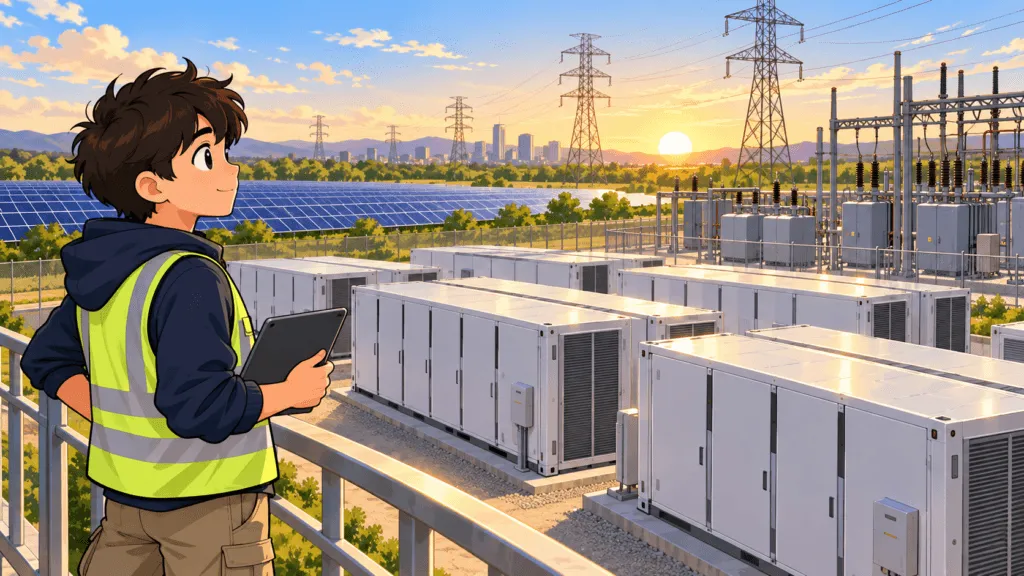
U.S. battery storage capacity reached nearly 52 GW by June 2026, according to the U.S. Energy Information Administration (EIA). This is operating utility-scale battery power capacity, not stored energy in GWh or residential battery capacity.
According to the latest U.S. Energy Information Administration data, utility-scale battery storage capacity reached nearly 52 gigawatts (GW) by the end of June 2026.
That is up from 43.6 GW at the end of 2025, meaning operators added about 8.3 GW in only the first six months of 2026.
Battery storage capacity has been growing at an average annual rate of about 70% over the last three years.
And the expansion is not finished.
Operators have reported plans for another 14 GW of battery capacity during the second half of 2026, although individual projects can always be delayed.
So why does the U.S. power grid suddenly need so many batteries?
The answer is bigger than renewable energy alone.
How Much Battery Storage Does the U.S. Have in 2026?
U.S. Battery Storage Capacity: Operating vs. Planned (2026)
| Period | Capacity | What the number means |
|---|---|---|
| End of 2025 | 43.6 GW | Operating utility-scale battery capacity |
| January–June 2026 | 8.3 GW added | New capacity that entered service during the first half |
| June 2026 | Nearly 52 GW | Operating utility-scale battery power capacity |
| July–December 2026 | 14 GW planned | Reported future additions, not operating capacity in the June data |
Do not confuse planned additions with operating capacity. Adding 14 GW to the June total gives a possible future scenario, not confirmed installed capacity. Projects can be delayed or revised. All the GW numbers describe maximum power, not stored energy in GWh. The charging/discharging losses that also affect delivered energy are explained in BESS Round-Trip Efficiency: AC vs DC Losses Explained.
In its August 7, 2026 report, EIA cited operating capacity through June 2026. The date matters: later monthly generator-inventory releases may revise these preliminary figures.
At that point, the United States had nearly:
52 GW of utility-scale battery nameplate power capacity.
That distinction matters.
GW measures how much power batteries can deliver at one time.
It does not tell us how long they can keep delivering that power.
For example, a hypothetical 100 MW battery capable of discharging for four hours would have about 400 MWh of usable energy capacity.
So when we say the United States has almost 52 GW of battery storage, we should not interpret that as 52 GWh of stored electricity.
Those are different measurements.
The growth is still remarkable.
U.S. battery capacity exceeded only about 26 GW at the end of 2024. By June 2026, it had nearly doubled.
Battery Storage Is Growing Much Faster Than Most Grid Technologies
EIA says operators added roughly 15 GW of battery storage during 2025, followed by another 8.3 GW during the first half of 2026.
Earlier this year, developers reported plans to add about 24 GW during all of 2026, making batteries the second-largest category of planned new U.S. utility-scale capacity after solar.
Texas is especially important.
About 12.9 GW, or 53% of the battery capacity originally planned for 2026, was expected in Texas.
California and Arizona were the next two largest markets.
That geography is not accidental.
These states already have large amounts of solar generation, and batteries become increasingly valuable when electricity production and electricity demand occur at different times.
Why Does the Grid Need Batteries?
A power grid has to balance electricity supply and demand continuously.
But solar power follows the sun.
Electricity demand does not.
During the middle of a sunny day, solar generation can become extremely strong. Several hours later, solar production falls rapidly while homes and businesses may still be using significant amounts of electricity.
Batteries can charge when electricity is abundant and discharge later when the grid needs it more.
That basic process is often called energy arbitrage.
EIA data shows that arbitrage has become the most important primary use for many utility-scale batteries.
In the latest annual use-case data, 41% of U.S. battery capacity reported arbitrage as its primary purpose, while frequency regulation accounted for another 24%.
But batteries can perform several jobs.
They can help with:
- shifting energy from low-price to high-price hours,
- frequency regulation,
- peak demand management,
- reserves,
- renewable-energy integration,
- and other grid-support services.
That flexibility is one reason batteries are being installed so quickly. For a practical look at large-load applications, see how data-center BESS can—and cannot—reduce grid costs.
👉 If you want the deeper explanation behind this expansion, read [Why Is Battery Energy Storage Growing So Fast in the U.S.?].
California Shows What Batteries Can Actually Do
California offers one of the clearest examples of large-scale battery operation.
Between April 2024 and April 2026, battery storage capacity operating in CAISO increased about 79% to 16 GW.
During the first five months of 2026, battery discharge was about three times higher than during the same period in 2024.
The typical pattern is straightforward.
Batteries charge during periods of strong solar production and then discharge later, especially during evening hours when solar generation drops.
This does not mean batteries replace natural gas, nuclear power, transmission or other generation.
A battery must first obtain electricity from somewhere.
What it does is allow the grid to move electricity through time.
That ability becomes increasingly valuable as the amount of variable generation grows.
Rising Electricity Demand Makes Storage More Valuable
There is another reason battery storage matters in 2026:
U.S. electricity demand itself is increasing again.
EIA’s September 2026 forecast expects U.S. electricity generation to reach a record level this year, driven partly by data-center development and increased manufacturing activity.
More electricity demand means grid operators need more resources capable of responding quickly when conditions change.
Batteries are particularly useful because power-electronic systems can react much faster than many conventional generators.
But they should not be treated as a substitute for every other grid investment.
If a region lacks enough generation or transmission capacity, simply installing batteries does not eliminate those underlying constraints.
👉 AI data centers are one of the loads changing this equation. See [AI Data Center Power Consumption in the U.S.] for a closer look at the new demand entering the grid.
Could U.S. Battery Storage Reach 60 GW in 2026?
It has effectively already cleared the harder milestone: 50 GW.
EIA reported nearly 52 GW operating by June and another 14 GW planned during the second half of the year.
If all of those reported projects entered service on schedule, total capacity would move into the mid-60-GW range.
That should not be treated as a guaranteed year-end number because project schedules change.
The broader pipeline is even larger.
Operators reported another 54 GW of planned battery capacity over the following two and a half years, including roughly 26 GW scheduled for 2027 and 14 GW for 2028.
So 50 GW looks less like an endpoint and more like another stage of a much larger buildout.
My View From the Electrical Construction Side
From an electrical construction perspective, a BESS project is much more than rows of battery containers.
Large installations also require transformers, switchgear, protection systems, power conversion equipment, cables, substations, fire-safety systems, controls and a grid interconnection capable of handling large bidirectional power flows.
As battery projects move from hundreds of megawatts toward gigawatt-scale portfolios, their connection to the grid becomes increasingly important.
That is why I see the U.S. battery boom as both an energy-storage story and an electrical infrastructure story.
The batteries receive most of the attention. The Fluence BESS business analysis provides an example of how storage demand connects to equipment integration, manufacturing and project delivery.
But everything required to safely charge, control, protect and discharge those batteries is just as important.
Final Thoughts
U.S. utility-scale battery storage has now passed 50 GW, reaching nearly 52 GW by June 2026.
That compares with 43.6 GW at the end of 2025 and about 26 GW at the end of 2024.
The reason for the rapid growth is not one single technology trend.
More solar generation creates opportunities to move energy from midday into the evening.
Electricity markets reward batteries for shifting energy between low- and high-price periods.
Grid operators can use them for frequency regulation and other reliability services.
And rapidly growing loads — including AI data centers and manufacturing — are increasing the value of flexible grid resources.
The next question is no longer whether large-scale batteries will become an important part of the U.S. grid.
They already are.
The more interesting question is:
How large will the U.S. battery fleet become after passing 50 GW?
Sources & Official References
This article was researched using U.S. Energy Information Administration data on operating battery capacity, planned projects, battery use cases and U.S. electricity demand.
U.S. Energy Information Administration — Battery storage capacity averaged 70% growth over the last three years
https://www.eia.gov/todayinenergy/detail.php?id=67925
U.S. Energy Information Administration — U.S. Battery Storage Market Trends
https://www.eia.gov/analysis/studies/electricity/batterystorage/
U.S. Energy Information Administration — New U.S. electric generating capacity expected to reach a record high in 2026
https://www.eia.gov/todayinenergy/detail.php?id=67205
U.S. Energy Information Administration — Utility-scale batteries are more commonly used for price arbitrage
https://www.eia.gov/todayinenergy/detail.php?id=66164
U.S. Energy Information Administration — September 2026 Short-Term Energy Outlook
https://www.eia.gov/outlooks/steo/report/elec_coal_renew.php
U.S. Energy Information Administration — Electric Power Monthly
https://www.eia.gov/electricity/monthly/
Sources checked September 14, 2026.
Is there something you’d like to see?
Suggest an electrical topic, practical guide, or calculator you would like to see on JHOTAS-LAB. Your suggestion may help shape future content.