
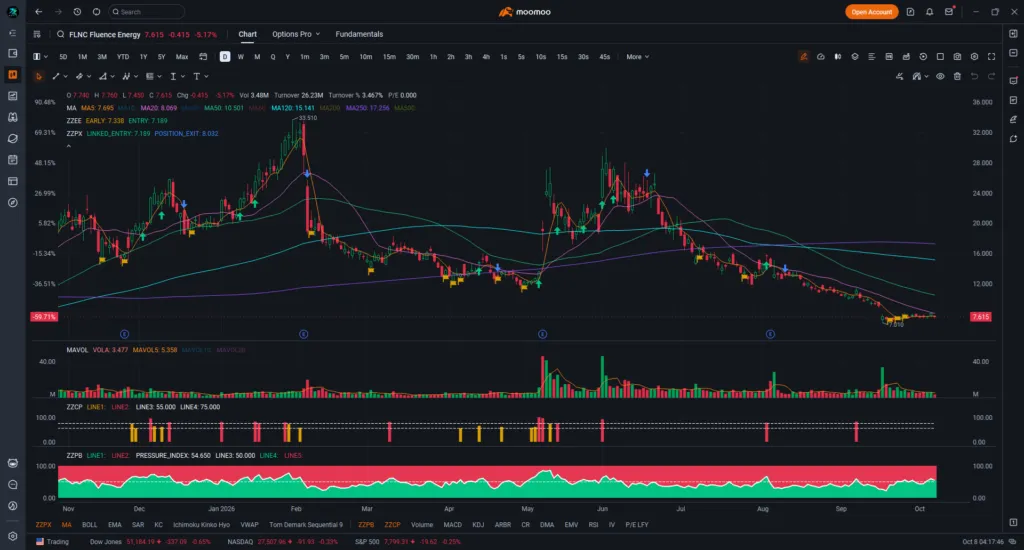
Fluence Energy (NASDAQ: FLNC) provides grid-scale BESS systems, integration and software, but growing U.S. battery demand has not eliminated its manufacturing and delivery risks. Record orders and backlog need to become completed projects, recognized revenue and stronger margins.
But a growing market does not guarantee that every company supplying that market will grow smoothly.
Fluence Energy (NASDAQ: FLNC) is a good example.
When JHOTAS-LAB covered the rapid expansion of U.S. battery storage on September 7, the industry picture looked strong: utility-scale battery capacity had already reached nearly 52 GW, with tens of gigawatts of additional projects planned.
Fluence sits directly inside that buildout.
The company supplies grid-scale battery systems, controls, services and software used to operate energy-storage assets.
But over the past month, Fluence has also shown why strong demand and successful execution are two different things.
👉 For the industry background behind this growth, read Why Is Battery Energy Storage Growing So Fast in the U.S.?.
What Fluence Energy Actually Does
Fluence is not primarily a battery-cell manufacturer.
Its role is closer to a large-scale BESS system integrator and technology provider.
The company combines battery packs, battery-management systems, controls, thermal management, software and project integration into complete energy-storage systems.
Its main grid-scale product platform is Gridstack Pro.
Depending on configuration, individual Gridstack Pro enclosures can contain roughly 2.4 MWh to more than 5.6 MWh of energy storage capacity.
The system is designed for applications such as peak capacity, frequency regulation, transmission and distribution support, renewable integration and microgrids.
Fluence also operates software businesses.
Mosaic helps battery and renewable-energy assets participate in wholesale electricity markets, while Nispera provides asset-performance monitoring and optimization.
That means Fluence’s business is broader than simply selling battery containers.
Its model includes:
BESS equipment → controls → project integration → long-term services → software
That structure matters because the U.S. battery boom requires all of those pieces.
The U.S. Storage Boom Is Showing Up in Fluence’s Orders
Demand itself does not appear to be Fluence’s biggest problem.
In its third fiscal quarter of 2026, the company reported more than $1.44 billion of new order intake, nearly three times the amount booked during the same quarter a year earlier.
Fluence’s contracted backlog reached approximately $6.4 billion, the highest level in company history.
Its energy-storage project pipeline reached 45.6 GW / 163.7 GWh, while contracted storage backlog reached 12.6 GW.
The company had also deployed approximately 19.3 GWh of storage systems by the end of June.
Those figures fit closely with the broader U.S. market trend.
Battery storage has already moved beyond a small renewable-energy niche and is becoming mainstream grid infrastructure.
👉 JHOTAS-LAB tracks that expansion in U.S. Battery Storage Passes 50 GW: Why the Grid Needs So Many Batteries.
But Fluence’s recent results also show why a large backlog cannot automatically be treated as current revenue.
Data Centers Are Becoming Part of the Fluence Story
Another interesting development is Fluence’s exposure to data-center infrastructure.
By July 2026, the company said it had secured approximately $850 million of data-center-related business.
That included its first large behind-the-meter storage order and around $550 million of awards from a hyperscale customer.
This brings Fluence into another theme JHOTAS-LAB has been following closely.
Large data centers may use battery storage for peak management, backup support, microgrids, flexible interconnection and reducing how much power they draw from the grid during constrained periods.
But BESS still does not generate electricity.
A battery can make a large load more flexible, but it cannot permanently replace the generation and transmission infrastructure needed to supply a continuously operating data center.
👉 For that distinction, read Can Battery Storage Reduce Data Center Grid Costs? What BESS Can—and Cannot—Do.
A Real Project Shows the Scale Fluence Is Targeting
One example of Fluence’s grid-scale business is the Pioneer Clean Energy Center in Arizona.
Fluence is supplying its Gridstack Pro technology for a project combining a 300 MW solar facility with a 300 MW / 1,200 MWh battery energy storage system.
The project is being developed by BrightNight and Cordelio Power.
A four-hour, 1,200 MWh installation shows the scale at which modern utility BESS projects are now being built.
This is very different from residential battery storage.
Projects at this scale require large amounts of power-conversion equipment, transformers, protection, cables, controls and grid-interconnection infrastructure in addition to the battery cells themselves.
The Problem: Fluence Has Orders but Manufacturing Has Fallen Behind
This is where the Fluence story becomes more complicated.
On September 16, the company sharply reduced its fiscal 2026 outlook.
Fluence lowered expected revenue to approximately $2.4 billion, compared with the previous guidance midpoint of around $3.0 billion.
Even more significant, expected adjusted EBITDA moved to a loss of approximately $200 million, compared with the previous guidance midpoint of roughly a $10 million loss.
The company said the main reason was continued supply-chain and production problems affecting its U.S. manufacturing ramp, particularly its contract manufacturing facility in Houston.
This followed earlier delays already disclosed in August.
At that time, Fluence said roughly $400 million of project deliveries were being pushed into fiscal 2027 because of production and construction delays at new manufacturing facilities.
That distinction is central to understanding the business.
Strong orders do not automatically become revenue on schedule.
A project has to be manufactured, delivered and recognized financially.
What the Price Chart Shows—and What It Cannot Tell Us
The original JHOTAS-LAB U.S. battery-storage article was published on September 7.
The previous completed U.S. trading session was September 4, when FLNC closed at $10.35.
By October 6, FLNC had closed at $8.03.
That represents a decline of approximately 22.4% from the pre-publication trading session.
The largest move came immediately after Fluence’s revised guidance.
FLNC closed at $9.05 on September 16 and then fell 15.4% to $7.66 on September 17, with trading volume rising to about 33.8 million shares.
The broader market behaved very differently.
SPY moved from $770.19 on September 4 to $779.09 on October 6, an increase of roughly 1.2%.
The chart therefore shows a clear period of FLNC underperformance.
But it does not prove that the long-term U.S. BESS market has weakened.
The company’s own disclosures point instead to a more specific problem: execution and manufacturing delays.
Business Reality: Backlog Is Not Revenue
Fluence illustrates one of the most important rules for following infrastructure companies.
$6.4 billion backlog does not equal $6.4 billion of current revenue.
Likewise:
163.7 GWh pipeline ≠ 163.7 GWh of contracted projects
and
strong BESS demand ≠ strong near-term margins.
The company reported third-quarter revenue of approximately $649.8 million, up from $602.5 million a year earlier.
But GAAP gross margin fell from approximately 14.8% to 5.1%.
Fluence also recorded a quarterly net loss of about $44.3 million.
So the commercial picture currently has two sides.
Demand and backlog look strong.
Execution and profitability remain much less convincing.
That is exactly why following the company after the initial industry article matters.
My View From the Electrical Construction Side
From an electrical-construction perspective, Fluence is one of the companies that makes the battery boom physical.
A utility-scale BESS cannot operate with battery cells alone.
It needs PCS equipment, transformers, switchgear, protection, communication systems, thermal management and a properly engineered grid connection.
At hundreds of megawatts, project execution becomes just as important as battery technology.
Manufacturing delays can therefore affect an entire project schedule even when customer demand remains strong.
Fluence currently shows both sides of the U.S. battery-storage boom:
large demand for new infrastructure and the difficulty of delivering that infrastructure fast enough.
What to Watch Next
October 2026 follow-up: The next test for Fluence Energy (FLNC) is whether stronger battery sourcing can support reliable deliveries and margin recovery, rather than simply expanding orders. Our Fluence and EVE Power battery supply update examines what the agreement changes and what manufacturing and project execution still need to prove.
For Fluence, the next indicators are relatively clear.
First, the Houston manufacturing facility needs to reach stable production.
Second, the approximately $400 million of delayed project deliveries need to convert into fiscal 2027 revenue rather than being delayed again.
Third, Fluence needs to show that its record backlog can translate into better gross margins and EBITDA.
Data-center orders are another important area to follow.
If the company’s early behind-the-meter and hyperscaler awards develop into repeat business, data centers could become a meaningful new BESS market alongside traditional utility projects.
The U.S. battery-storage market itself still appears to be expanding rapidly.
For Fluence, the question is increasingly not whether demand exists.
It is whether the company can manufacture, deliver and profit from that demand consistently.
Sources & Official References
Fluence Energy — Third Fiscal Quarter 2026 Results
https://ir.fluenceenergy.com/news-releases/news-release-details/fluence-energy-inc-reports-third-fiscal-quarter-2026-results Fluence
Fluence Energy — Revised Fiscal Year 2026 Guidance, September 16, 2026
https://ir.fluenceenergy.com/news-releases/news-release-details/fluence-energy-announces-revised-guidance-fiscal-year-2026 Fluence
Fluence Energy — Gridstack Pro Energy Storage Platform
https://fluenceenergy.com/gridstack-pro-energy-storage/ Fluence Energy
Fluence Energy — Pioneer Clean Energy Center, 300 MW / 1,200 MWh
https://ir.fluenceenergy.com/news-releases/news-release-details/fluence-supplies-energy-storage-technology-brightnight-and Fluence
FLNC Historical Prices
https://stockanalysis.com/stocks/flnc/history/
Is there something you’d like to see?
Suggest an electrical topic, practical guide, or calculator you would like to see on JHOTAS-LAB. Your suggestion may help shape future content.