Battery energy storage is becoming one of the fastest-growing parts of the U.S. power grid.
And the numbers are getting difficult to ignore.
U.S. utility-scale battery storage capacity reached nearly 52 GW by June 2026, after operators added another 8.3 GW during the first half of the year.
According to the U.S. Energy Information Administration, battery capacity has grown at an average annual rate of about 70% over the last three years. Developers have reported plans for another 54 GW of battery storage over the next two and a half years.
So why is battery energy storage growing so quickly?
The answer is not one single trend.
It is the combination of rapid solar growth, rising electricity demand, evening peak loads, grid reliability needs, and the ability of batteries to move electricity from one part of the day to another.
1. The U.S. Is Adding Huge Amounts of Solar
Solar and batteries increasingly make sense together.
The EIA reported that developers planned to add about 43.4 GW of utility-scale solar capacity in 2026, along with roughly 24 GW of battery storage. Battery storage alone represented about 28% of planned new utility-scale capacity for the year.
The reason for pairing them is simple.
Solar production is strongest during the day.
But electricity demand often remains high into the evening after solar production begins falling.
A battery can charge when solar generation is abundant and discharge later when electricity is more valuable or the grid is under greater stress.
Texas already provides a clear example.
During summer 2025, batteries in ERCOT supplied an average of about 4 GW at 8 p.m., helping support the grid as solar generation declined.
That evening transition is one of the strongest use cases for battery storage.
2. Batteries Can Shift Electricity to More Valuable Hours
Electricity does not have the same value at every hour of the day.
When generation is abundant and demand is relatively low, wholesale electricity prices can fall.
Later, when demand rises and available generation becomes tighter, prices can increase substantially.
Battery operators can take advantage of this difference through energy arbitrage:
Charge when electricity is cheap → discharge when electricity is expensive.
EIA data shows that arbitrage has become one of the most common uses of U.S. utility-scale batteries. In its latest detailed use-case data, 66% of battery capacity reported arbitrage as one of its uses, while 41% identified it as the primary use.
That means a battery is not simply emergency backup equipment.
It can operate as an active grid asset every day.
3. U.S. Electricity Demand Is Growing Again
Another major change is happening on the demand side.
AI data centers, semiconductor plants, manufacturing facilities, EV charging, and building electrification are creating large new electrical loads.
This matters because the U.S. grid increasingly needs resources that can respond quickly when demand changes.
Battery storage cannot create electricity.
But it can store available electricity and deliver it when the system needs additional power.
That flexibility becomes increasingly valuable as large new loads connect to the grid.
This is especially important during periods when electricity demand is high but solar output is beginning to fall.
4. Batteries Can Respond Extremely Fast
Traditional power plants and battery systems behave very differently.
A battery can change its power output extremely quickly.
That makes BESS useful for:
- Frequency regulation
- Peak shaving
- Load management
- Operating reserves
- Renewable energy balancing
- Short-duration grid support
EIA notes that battery storage can respond on second, minute, and hourly timescales, making it particularly useful for maintaining the balance between electricity supply and demand.
This flexibility is one reason grid operators increasingly view storage as more than simply a renewable-energy accessory.
It has become a grid reliability resource.
5. Grid Operators Are Already Seeing Reliability Benefits
Texas provides a particularly interesting example.
NERC’s 2026 summer reliability assessment found that continued battery growth contributed to a lower probability of emergency conditions in ERCOT during high-risk evening hours.
Battery energy storage capacity in the region had increased by another 2,677 MW year over year by March 2026, helping reduce modeled emergency risk compared with earlier assessments.
That does not mean batteries eliminate blackout risk.
Extreme heat, transmission constraints, generator outages, and rapidly growing loads can still create problems.
But batteries provide operators with another fast-responding resource when grid conditions become tight.
6. Utility-Scale Storage Has Moved Into the Mainstream
The market is no longer growing from a tiny base.
In the first quarter of 2026 alone, the United States installed 3.3 GW / 8.4 GWh of battery energy storage across utility, commercial, and residential sectors.
That was 54% higher than the previous first-quarter record.
Utility-scale projects accounted for most of the new capacity.
ACP and Wood Mackenzie now project cumulative U.S. energy storage installations could reach approximately 200 GW / 655 GWh by 2031.
At that scale, battery storage is no longer a niche technology.
It becomes part of normal power-system planning.
My View From the Electrical Construction Side
From my perspective working in electrical construction, I think there is an important point that sometimes gets lost when people talk about batteries.
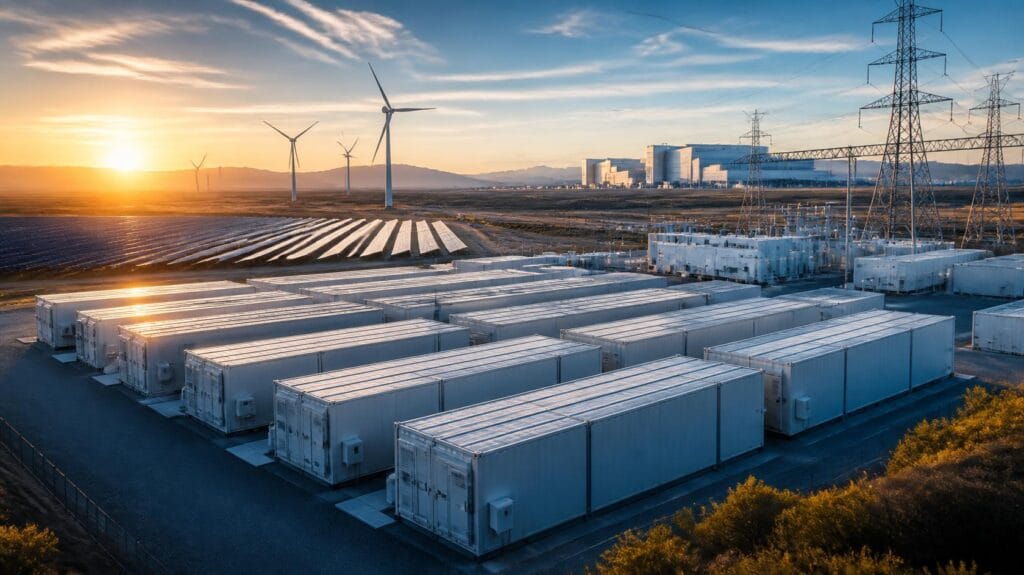
A BESS project is much more than battery cells.
A large storage facility also needs:
- Power conversion systems
- Transformers
- Switchgear
- Protection systems
- Cables
- Monitoring and control equipment
- Fire protection
- Grid interconnection infrastructure
The battery stores the energy, but the electrical infrastructure around it is what allows hundreds of megawatts to move safely between the battery and the grid.
That is why I think the U.S. battery boom is also an electrical infrastructure boom.
If battery capacity continues growing at this speed, opportunities will expand not only for battery manufacturers but also for electrical equipment suppliers, engineering firms, utilities, and electrical construction companies.
Final Thoughts
Battery energy storage is growing so quickly in the United States because several major trends are happening at the same time.
Solar generation is expanding.
Electricity demand is growing.
Evening peak demand remains difficult.
The grid needs faster flexible resources.
And batteries can move electricity to the hours when it is needed most.
The U.S. already has nearly 52 GW of utility-scale battery capacity, and another 54 GW is planned over the next two and a half years.
For me, that makes the bigger story clear.
Battery storage is no longer simply something attached to a solar project.
It is becoming a major piece of U.S. electrical infrastructure.
And as electricity demand from AI, electrification, and new industrial loads continues to rise, the value of that flexibility may become even more important.
Is there something you’d like to see?
Suggest an electrical topic, practical guide, or calculator you would like to see on JHOTAS-LAB. Your suggestion may help shape future content.