
For years, U.S. electricity demand barely moved.
Efficiency improvements in lighting, appliances, motors and buildings helped offset economic and population growth. But that pattern is changing.
In 2026, electricity demand is rising again — and one of the biggest reasons is the rapid expansion of AI and data centers.
The U.S. Energy Information Administration expects electricity sales to reach about 4,135 billion kilowatthours in 2026, nearly 2% higher than in 2025, before rising again to about 4,211 billion kWh in 2027.
Data center development and increased manufacturing activity are major drivers of that growth.
This is more than a story about computers using more electricity.
It is beginning to change how utilities plan power plants, transmission lines, substations and energy storage.
U.S. Electricity Demand Is Growing Again
The scale of the shift becomes clearer when looking at the longer trend.
According to the EIA’s 2026 Annual Energy Outlook, national electricity demand has grown by approximately 2.1% per year over the previous five years, following more than a decade of relatively flat demand.
The EIA now identifies data-center load as an emerging dominant driver of long-term U.S. electricity growth.
Other factors matter too.
New manufacturing facilities, electrification, population growth and increasingly large cooling loads can all raise electricity consumption.
But AI data centers are different because of both their size and concentration.
A new data-center campus may require hundreds of megawatts of capacity in one location instead of electricity demand being spread gradually across thousands of homes and businesses.
That creates a very different engineering problem for the grid.
👉 For a closer look at how much electricity these facilities can use, see [AI Data Center Power Consumption in the U.S.].
How Much Electricity Could Data Centers Use?
The numbers are becoming substantial.
A June 2026 update from Lawrence Berkeley National Laboratory estimated that U.S. data centers could account for about 11.8% of total U.S. electricity consumption by 2030 under its central estimate.
Depending on how the industry develops, the modeled range extends from roughly 9.5% to 15.3%.
That does not mean every data center is an AI facility.
Traditional cloud computing, storage and other digital services still consume significant electricity.
However, AI is accelerating the trend because advanced computing hardware can require enormous amounts of power while also producing heat that must be removed through cooling systems.
Berkeley Lab previously estimated that U.S. data centers consumed around 176 TWh in 2023, or approximately 4.4% of U.S. electricity, illustrating how quickly the sector has expanded.
Why AI Data Centers Are Harder for the Grid
From an electrical infrastructure perspective, the challenge is not simply annual energy consumption.
Capacity matters. Location matters. Timing matters.
FERC noted in 2026 that new large loads are increasingly bigger and more concentrated than traditional load growth.
The average size of data centers entering service increased from about 25 MW in 2020 to nearly 80 MW in 2025, while proposed future projects can be substantially larger.
Connecting a load of that size may require:
- additional generating capacity,
- new or upgraded transmission lines,
- larger substations and transformers,
- distribution-system upgrades,
- and additional capacity to maintain reliability during peak periods.
The difficulty becomes greater when multiple large projects want electricity in the same region at roughly the same time.
This is already visible in areas such as Virginia and Texas.
PJM Shows How Fast the Load Forecast Is Changing
PJM operates the power grid across all or parts of 13 states and Washington, D.C., including Northern Virginia — one of the largest data-center markets in the world.
Its 2026 long-term forecast projects summer peak electricity demand to grow by an average of approximately 3.6% per year over the next decade.
PJM forecasts summer peak demand reaching about 222 GW by 2036, approximately 66 GW above its starting point in the forecast.
This creates a planning challenge.
Power plants can take years to permit and construct. Major transmission projects can take even longer.
AI infrastructure, meanwhile, can develop much faster.
The result is a race between new electrical load and new electrical infrastructure.
More Electricity Demand Does Not Mean One Energy Source Wins
It is tempting to assume that AI growth automatically means more natural gas, nuclear power, solar or batteries.
In reality, the grid will probably need a combination.
EIA expects new solar projects and natural-gas generation to provide much of the near-term growth in U.S. electricity supply. Its September 2026 forecast expects total electricity generation to rise 2.2% to a record 4,368 billion kWh in 2026, followed by another 1.7% increase in 2027.
At the same time, utilities and technology companies are looking at nuclear generation, long-term power contracts and energy storage.
Batteries are particularly useful for moving electricity between hours and responding quickly to changing grid conditions, although they do not replace the need for adequate generation and transmission.
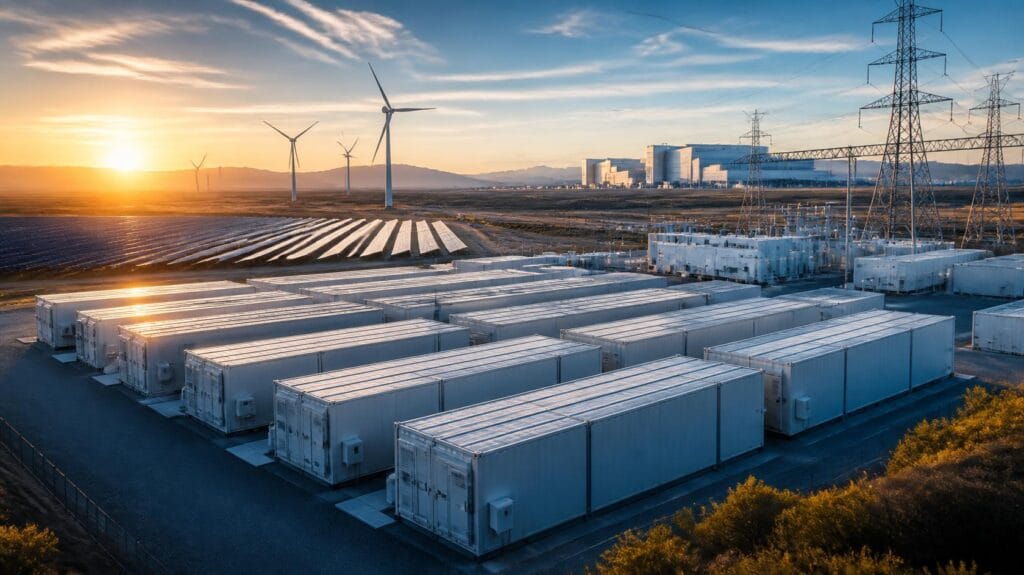
👉 This is one reason grid-scale storage is expanding rapidly. Read [Why Is Battery Energy Storage Growing So Fast in the U.S.?] for more on the role of batteries.
Who Pays for the Grid Upgrades?
This may become one of the most important parts of the data-center electricity debate.
Building new substations, transmission lines and generating resources costs money.
If infrastructure is constructed specifically for a large data center, regulators must decide how much of that cost should be paid by the new customer and how much, if any, should be spread across existing electricity customers.
FERC took action in June 2026 requiring regional grid operators to examine or reform rules for connecting large loads such as data centers.
One focus is preventing infrastructure costs from being shifted unfairly to residential customers if a proposed large project is delayed or never built.
That means AI is beginning to influence not only electricity consumption but also utility regulation and rate design.
My View From the Electrical Construction Side
From an electrical construction perspective, AI is ultimately a physical infrastructure story.
A data center may be described as software or computing infrastructure, but behind that computing power are transformers, switchgear, protection systems, cables, substations, transmission facilities, backup systems and cooling equipment.
That is why rapidly rising AI demand can affect industries far beyond semiconductor manufacturing.
If electricity demand continues growing at the current pace, the challenge will not simply be producing enough energy.
The harder question may be whether the United States can build the grid infrastructure required to deliver that power to the right locations quickly enough.
Final Thoughts
U.S. electricity demand is rising again after years of relatively slow growth.
AI data centers are not the only reason. Manufacturing growth, electrification and weather-related demand also matter.
But data centers are becoming one of the most important new sources of concentrated electricity demand.
That is forcing utilities and grid operators to rethink generation, transmission, substations, storage and even who pays for new infrastructure.
The AI boom may be happening inside server racks, but one of its biggest constraints could ultimately be outside the data center:
the electric grid.
Sources & Official References
This article was researched using official U.S. government, grid operator, and national laboratory sources. Electricity demand forecasts and generation data were checked against the U.S. Energy Information Administration’s 2026 outlooks, while data center electricity consumption estimates were based on research from Lawrence Berkeley National Laboratory. Regional grid-demand forecasts were referenced from PJM Interconnection, and information about the connection of large loads such as AI data centers was reviewed using Federal Energy Regulatory Commission materials.
U.S. Energy Information Administration — Short-Term Energy Outlook
https://www.eia.gov/outlooks/steo/report/elec_coal_renew.php
U.S. Energy Information Administration — Annual Energy Outlook 2026
https://www.eia.gov/pressroom/releases/press587.php
Lawrence Berkeley National Laboratory — U.S. Data Center Energy Usage
https://seta.lbl.gov/publications/united-states-data-center-energy-2025
PJM Interconnection — Load Forecast Development
https://www.pjm.com/planning/resource-adequacy-planning/load-forecast-dev-process
Federal Energy Regulatory Commission — Large Load Integration
https://www.ferc.gov/news-events/news/ferc-launches-aggressive-targeted-action-speed-large-load-integration
Sources checked September 10, 2026.
Is there something you’d like to see?
Suggest an electrical topic, practical guide, or calculator you would like to see on JHOTAS-LAB. Your suggestion may help shape future content.